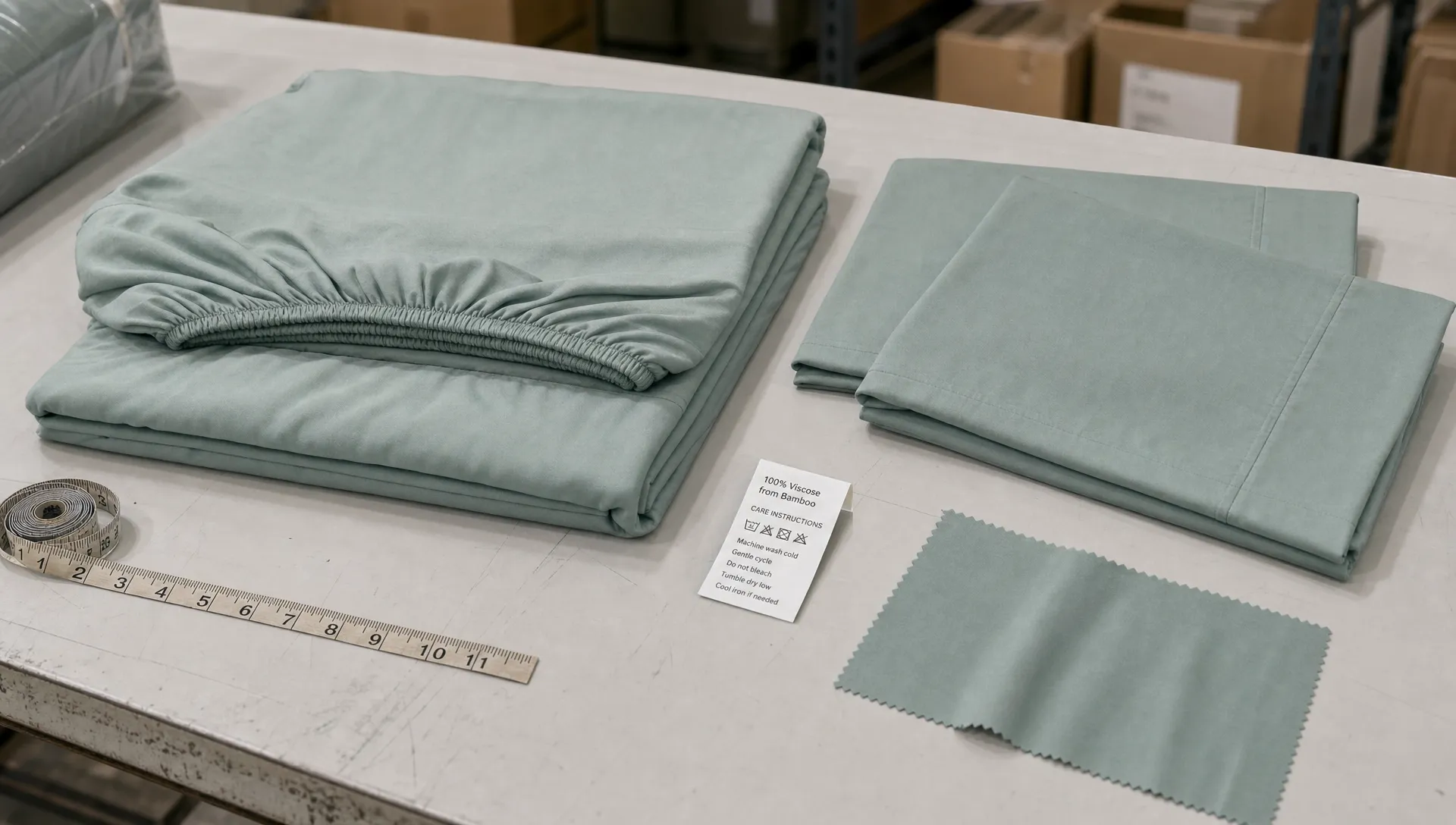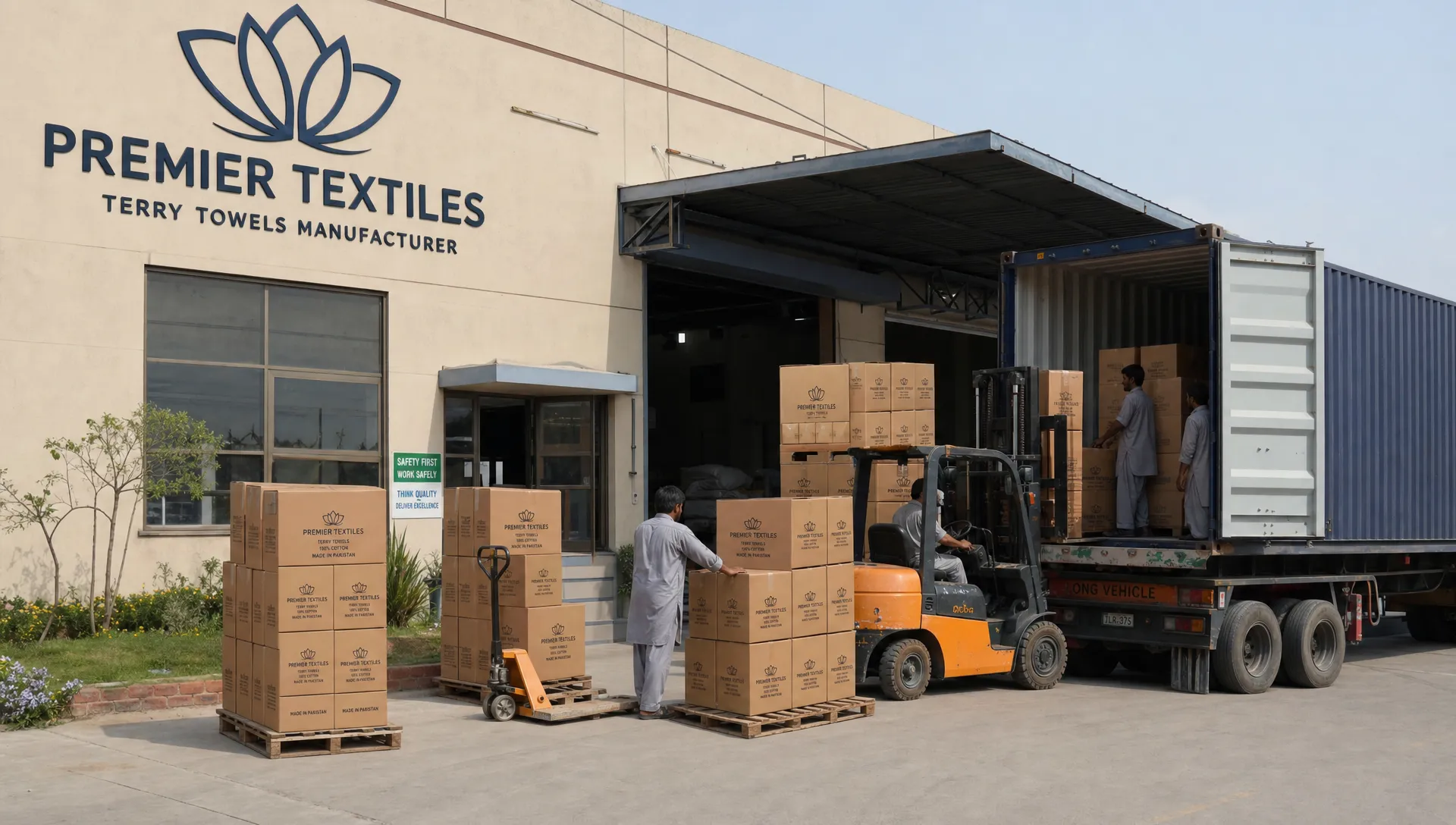
Choosing an OEM hotel towel manufacturer is not simply a price exercise. Towels carry the daily evidence of a hotel brand: softness, absorbency, whiteness and how the product looks after repeated commercial laundering. A low unit cost can become expensive fast if towels shrink outside tolerance, shed lint, lose color or need replacement earlier than planned.
For hotel groups, wholesalers, distributors and private-label buyers, the goal is to vet a manufacturing partner before the purchase order is signed. That means turning factory claims into evidence: specifications, samples, certificates, inspection records, production controls and export competence.
This guide walks through a practical vetting process for international buyers sourcing from Pakistan or any other textile manufacturing hub.
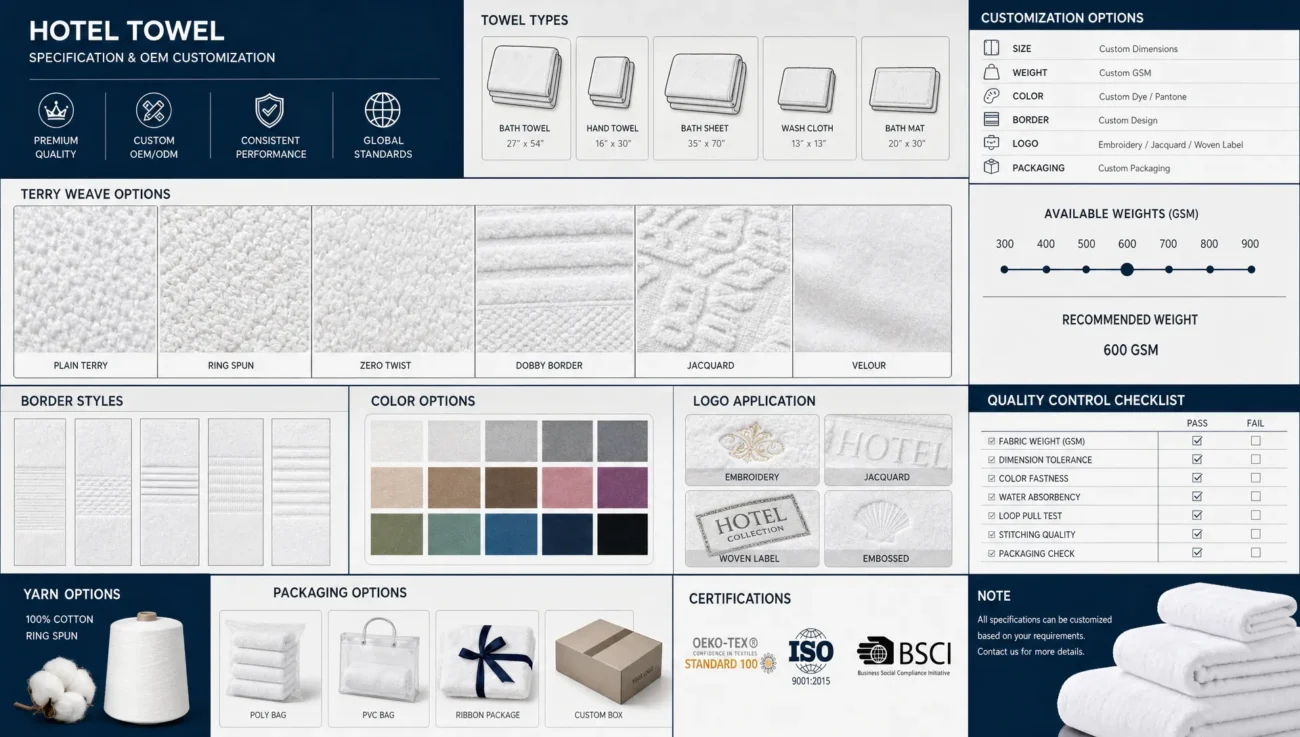
Start With a Precise Hotel Towel Specification
A serious OEM hotel towel manufacturer cannot quote accurately from a vague request such as white bath towel, 500 GSM. Two towels with the same GSM can perform very differently depending on yarn, weave density, pile height, finishing, hemming and dyeing process.
Before contacting suppliers, prepare a technical sheet that defines the towel you want to produce. If you are replacing an existing line, include a physical reference sample and note what must be improved. If you are creating a new hotel program, align the specification with property category, laundry process, target price and expected replacement cycle.
| Spec area | What to define | Why it matters |
|---|---|---|
| Fiber composition | 100 percent cotton, cotton blend, bamboo blend or other material | Affects softness, absorbency, durability and cost |
| GSM | For example, 450, 500, 550, 600 or higher | Helps define weight and feel, but should not be judged alone |
| Size and tolerance | Bath towel, hand towel, washcloth, bath sheet and allowed shrinkage | Prevents inconsistent room presentation after laundering |
| Yarn and construction | Ring spun, combed cotton, open-end, terry pile type and border style | Impacts hand feel, linting and durability |
| Color and finish | White, dyed shade, optical brightness, softener limits and colorfastness | Supports brand consistency and commercial laundry performance |
| Branding | Dobby border, jacquard logo, embroidery, woven label or printed label | Determines what equipment and sampling steps are required |
| Packaging | Piece fold, bundle quantity, polybag, carton strength and carton marks | Affects storage, distribution and property-level handling |
| Testing requirements | Absorbency, shrinkage, lint, colorfastness and seam strength | Creates objective approval criteria before bulk production |
A complete spec sheet also protects both sides. The manufacturer knows what to build, and the buyer has a reference point for sample approval, inspection and dispute resolution.
Confirm the Supplier Is a Real Manufacturing Fit
Not every supplier that offers OEM towels is the right factory for hotel programs. Some are trading companies, some specialize in promotional towels and some produce retail styles that do not meet the expectations of commercial hospitality buyers.
A capable OEM hotel towel manufacturer should be able to explain its production flow clearly. Ask where weaving, dyeing, finishing, cutting, stitching, inspection and packing take place. Outsourcing one process is not automatically a problem, but the supplier must control quality across every step and disclose who is responsible for each stage.
Buyers sourcing from Pakistan should also understand the local factory ecosystem. Pakistan has deep experience in terry towel production, but capability still varies by factory. If you want a deeper checklist for on-site or remote supplier evaluation, this guide on what to check at a towel factory in Pakistan covers factory fit, materials, certifications and quality control in more detail.
When vetting the supplier, ask direct questions such as:
- What hotel towel categories do you manufacture most often?
- Which production steps are in-house and which are subcontracted?
- What is your monthly capacity for the towel sizes and GSM we need?
- Can you produce repeat orders with the same yarn, shade and finish?
- Do you already export to our target market or region?
- Can you provide recent inspection reports or sample test results?
The answers should be specific. A vague yes to every request is less reassuring than a manufacturer that explains limitations, recommends improvements and identifies possible risks before production.
Verify Certifications and Compliance Early
Compliance requirements differ across the USA, Canada, Europe, Japan, Australia and other import markets. The right certifications depend on your customer expectations, distribution channel and product claims.
For hotel towels, common buyer concerns include restricted substances, dye safety, traceability, quality management and social compliance. If you require OEKO-TEX certification, do not accept a logo in a presentation as proof. Ask for the certificate number, scope, product class and validity, then confirm that the certificate applies to the exact product or process you are buying. For a dedicated walkthrough, review how buyers can source OEKO-TEX certified towels for hospitality.
Compliance is not only about certificates. Commercial hospitality textiles must also survive industrial use. Hotels care about whiteness retention, dimensional stability, border strength, absorbency and the towel's ability to keep a premium feel after repeated laundering. This is why supplier vetting should connect certificates with performance testing and a documented quality plan. Extreme Towel has also explained how hospitality fabric manufacturers meet commercial standards across towels, bedding and related textile categories.
Test Samples Like a Buyer, Not a Consumer
A sample towel can feel excellent on day one and fail after ten washes. Hotel buyers need to judge samples through the lens of commercial use, not showroom presentation.
Start by requesting a development sample based on your target specification. Once the construction is approved, request a pre-production sample made with the intended yarn, color, border, label, finishing and packaging. The pre-production sample should become the reference standard for bulk inspection.
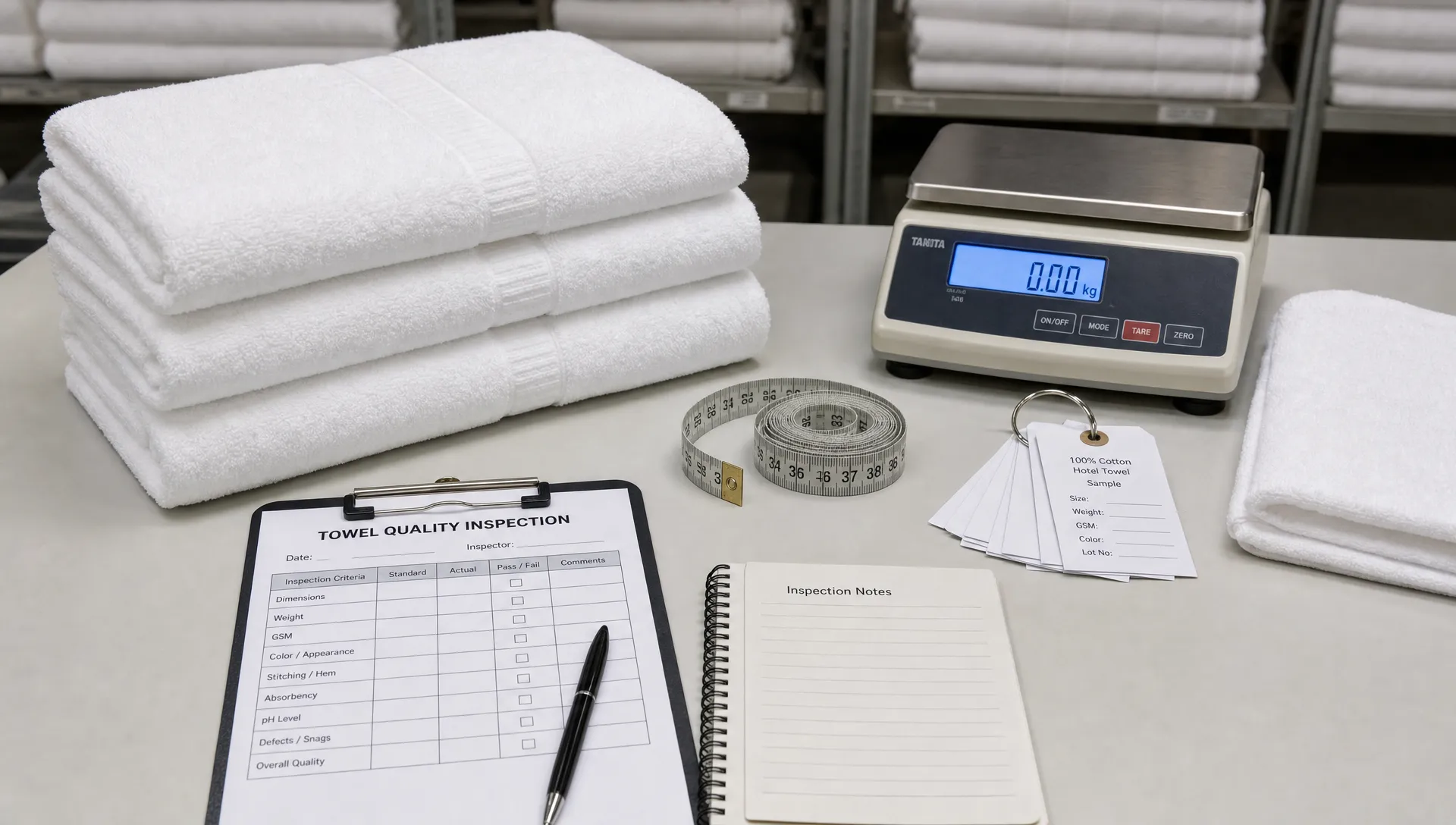
Sample evaluation should include both touch and measurable performance. If the order is large or part of a long-term program, consider using a third-party textile lab or your own laundry partner for controlled testing.
| Sample check | What to review | Acceptable sign |
|---|---|---|
| Weight | GSM and piece weight before and after washing | Within agreed tolerance |
| Shrinkage | Size change after repeated wash and dry cycles | Predictable and within the approved limit |
| Absorbency | Time needed to absorb water and overall water pickup | Fast absorption without heavy chemical finish blocking performance |
| Linting | Fiber shedding during use and laundering | Low lint after initial washes |
| Colorfastness | Shade change, bleeding or staining | Stable shade for dyed towels and consistent whiteness for white towels |
| Stitching | Hem strength, skipped stitches and loose threads | Clean, secure and repeatable stitching |
| Hand feel | Softness, bulk and recovery after laundering | Comfortable without sacrificing durability |
Do not approve a sample based only on softness. Excessive softener can make a towel feel impressive at first but reduce absorbency. A well-vetted OEM hotel towel manufacturer should understand this tradeoff and help balance softness with long-term performance.
Audit the Quality Control System
Quality control is where many towel programs succeed or fail. The approved sample is only useful if the factory has a system to keep bulk production aligned with it.
Ask the manufacturer to describe inspection points from yarn receiving to final carton sealing. Strong suppliers usually monitor raw material quality, loom output, dyeing or bleaching results, cutting accuracy, stitching quality, shade consistency, metal contamination risk and packing accuracy. For export orders, final inspection should confirm carton marks, assortment, labels, barcode requirements if applicable and packing list accuracy.
An inspection plan should define what is checked, how many pieces are checked and what happens when defects are found. Many buyers use AQL-based final inspections, but inline checks are just as important because they catch issues before the full order is packed.
Useful quality documents include:
- Approved sample record with date, style code and signature or written approval
- Production specification sheet used by the factory floor
- Inline inspection notes for weaving, dyeing, stitching and packing
- Final inspection report with defect categories and photos
- Carton packing list with gross weight, net weight and dimensions
- Shade band or whiteness standard for repeat programs
If a supplier cannot show how quality is controlled, the buyer is taking on risk that may only appear after goods arrive.
Review OEM Customization Capabilities
OEM towel sourcing often involves more than size and GSM. Hotel groups may need a branded dobby border, jacquard logo, embroidery, custom labels, hanger loops, laundry coding or private-label packaging. Distributors may need carton marks for multiple customers or packaging designed for wholesale handling.
Ask the manufacturer for real examples of similar customization work. If you need a jacquard logo, confirm that the logo can be woven cleanly at the towel size and pile construction you selected. If you need embroidery, check stitch density, backing, placement and how the embroidered area feels after laundering. If you need retail-style packaging, make sure the factory can maintain towel presentation without compressing the pile too aggressively.
The key question is not whether customization is available. It is whether the supplier can repeat it accurately in bulk.
Compare Pricing by Total Value, Not Unit Cost Alone
A proper quotation from an OEM hotel towel manufacturer should do more than list a price per piece. It should identify the product specification, MOQ, sample terms, production lead time, packaging, carton size, estimated carton weight, payment terms and Incoterms.
For international buyers, the unit price is only one part of the purchasing decision. Compare total landed cost, including freight, duties, customs clearance, inland transport, warehousing and the cost of quality problems. A towel that costs slightly more but lasts longer in a hotel laundry can be cheaper on a cost-per-use basis.
Be cautious if one quote is far below the market without a clear reason. The difference may come from lower yarn quality, reduced size, lighter actual GSM, weaker stitching, cheaper packaging or less rigorous inspection. Ask suppliers to explain cost drivers openly. A manufacturer that can show options, such as good, better and premium constructions, gives you more control than a supplier that only competes on the lowest possible price.
Check Export and Logistics Readiness
Export experience matters when buying towels from overseas. A manufacturer may produce a good towel but still create problems if documents are inaccurate, cartons are weak or shipment coordination is poor.
Ask whether the supplier has experience shipping to your destination market. For buyers in the USA, Canada, Europe, Australia, Japan and South Africa, documentation accuracy can affect customs clearance and delivery timelines. Commercial invoices, packing lists, country of origin details, carton marks and product descriptions should match the purchase order and shipping documents.
Packaging should also be planned for the full journey. Towels are bulky, and carton strength matters when goods move through ocean freight, warehouses and regional distribution. Confirm carton dimensions, loading plans and whether the supplier can support mixed-size towel programs without packing confusion.
Some importers also plan domestic buffer stock once goods arrive. If you are supplying properties across the United States and need secure overflow space for towel cartons between seasons, certified shipping containers for overflow storage can be part of the receiving plan, especially when warehouse space is tight.
Evaluate Communication and Account Management
The best factory relationship is built before a problem appears. During sampling and quotation, pay attention to how the manufacturer communicates. Slow replies, incomplete answers and inconsistent documents are early warning signs.
A strong supplier will confirm details in writing, track revisions, ask practical questions and push back when a request could hurt quality. For example, if you request a very soft finish for a towel that must absorb quickly, the manufacturer should explain the compromise. If you request a tight delivery date, the supplier should clarify what is realistic based on yarn availability, dyeing capacity and inspection time.
For buyers across multiple time zones, account management also matters. You need a contact who can coordinate technical questions, production updates, inspection schedules and shipping details without losing information between departments.
Watch for Red Flags Before Placing Bulk Orders
A rushed supplier selection can lock you into months of quality issues. Red flags do not always mean you should reject a supplier immediately, but they do mean you should slow down and ask for proof.
Common warning signs include:
- The supplier quotes without asking for full specifications
- The factory cannot explain its production process
- Certificates are expired, unclear or unrelated to the product
- Sample quality is strong but bulk control is not documented
- The supplier avoids wash testing or third-party inspection
- Product weights and sizes change between quote and sample
- Packaging details are treated as an afterthought
- The supplier pressures you to skip sample approval and move to bulk
A reliable OEM hotel towel manufacturer should welcome a structured vetting process. Professional buyers ask detailed questions, and professional factories are prepared to answer them.
A Simple Manufacturer Vetting Scorecard
Use a scorecard to compare suppliers consistently. This avoids choosing based on the best sales presentation and helps your procurement, quality and operations teams align.
| Vetting area | What good looks like | Risk if weak |
|---|---|---|
| Product fit | Clear experience with hotel towels and commercial laundering needs | Retail-style towels may fail in hospitality use |
| Technical quoting | Detailed quote tied to GSM, size, yarn, finish and packaging | Prices are not comparable across suppliers |
| Sampling | Development and pre-production samples match the agreed spec | Bulk goods may differ from approval sample |
| Certifications | Valid documents with relevant scope and traceability | Compliance claims may not support your market requirements |
| Quality control | Inline and final inspection plan with records | Defects may be found only after arrival |
| Customization | Proven ability to repeat labels, logos, borders and packaging | Brand presentation may be inconsistent |
| Export readiness | Accurate documents, strong cartons and destination market experience | Delays, extra costs and receiving problems |
| Communication | Written confirmations, realistic timelines and proactive updates | Small misunderstandings become production issues |
The best choice is usually not the cheapest factory or the largest factory. It is the supplier whose capabilities match your towel program, target market and risk tolerance.
Frequently Asked Questions
What is an OEM hotel towel manufacturer? An OEM hotel towel manufacturer produces towels according to a buyer's required specification, branding and packaging. The buyer controls details such as size, GSM, fiber, border, label and carton requirements, while the manufacturer handles production and export support.
How can I tell if a towel supplier is a factory or a trader? Ask for production flow details, factory photos or video, machine capability, inspection records and references for similar products. A genuine manufacturing partner should be able to explain how towels move from yarn to packed cartons.
Which towel sample should be approved before bulk production? Approve a pre-production sample made with the intended yarn, construction, color, finish, label and packaging. This sample should become the standard for bulk inspection.
Which certifications matter for hotel towels? It depends on your market and customer requirements. Many buyers ask for OEKO-TEX, quality management documentation, social compliance records or restricted substance testing. Always verify certificate validity and scope.
Is GSM the most important factor in hotel towel quality? GSM is important, but it is not enough. Yarn quality, weave, finishing, absorbency, shrinkage control, linting and stitching all affect how a hotel towel performs.
How long should supplier vetting take? The timeline depends on sample development, testing and approval requirements. For a new OEM program, allow enough time for technical discussion, sample review, laundering tests, pricing confirmation and final production planning.
Build a More Reliable Hotel Towel Program
Vetting an OEM hotel towel manufacturer is about reducing uncertainty before you commit to bulk production. Clear specifications, verified certifications, tested samples, documented quality control and export readiness all help protect your brand and your margins.
Extreme Towel works with hotels, hospitality brands, wholesalers, distributors and private-label customers worldwide, offering OEM terry towel manufacturing, hotel linen production, bulk orders, custom packaging and export support from Pakistan. If you are preparing a new towel program or reviewing your current supplier base, explore Extreme Towel's OEM towel manufacturing in Pakistan capabilities and start with a clear specification for your next order.