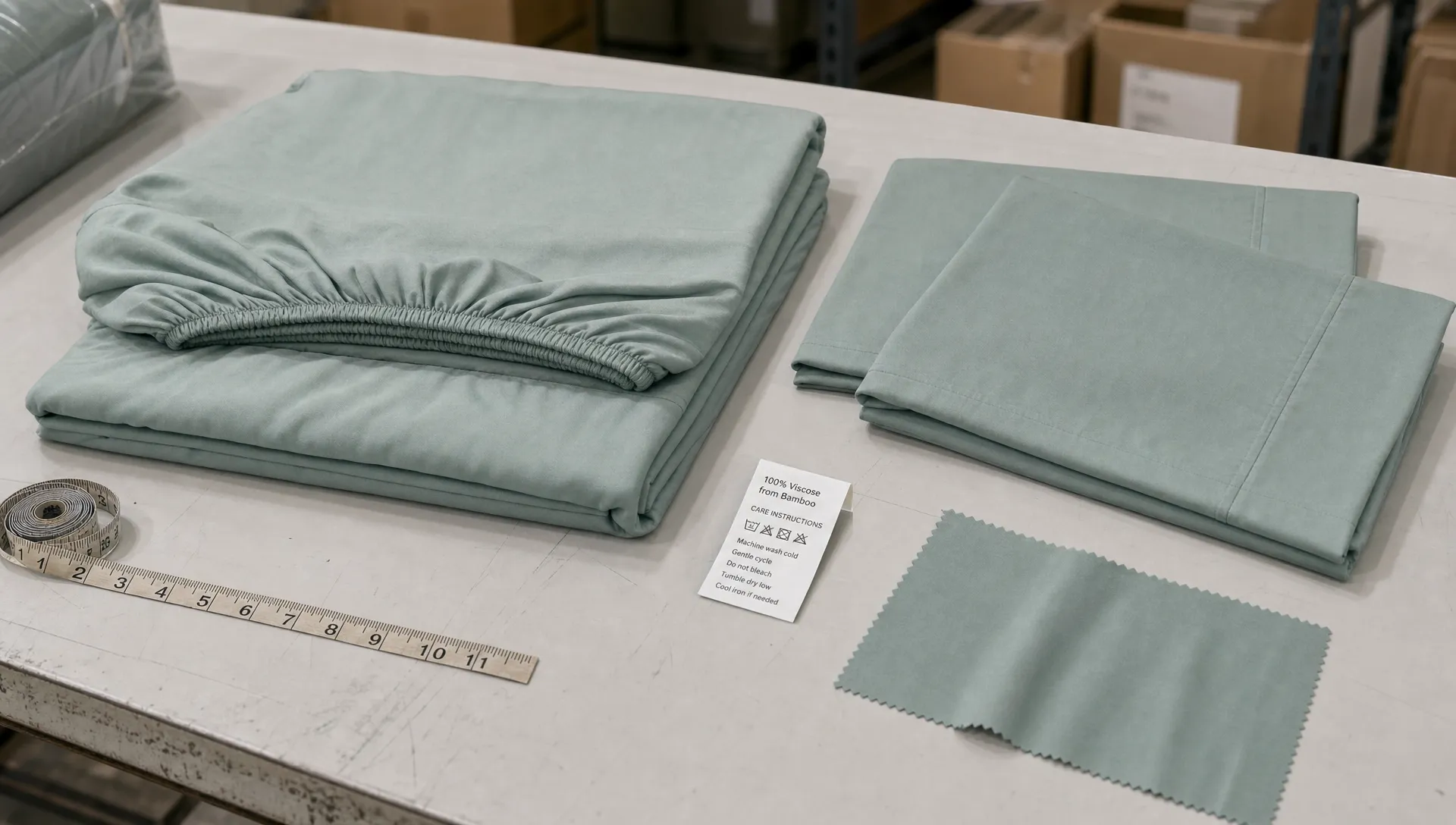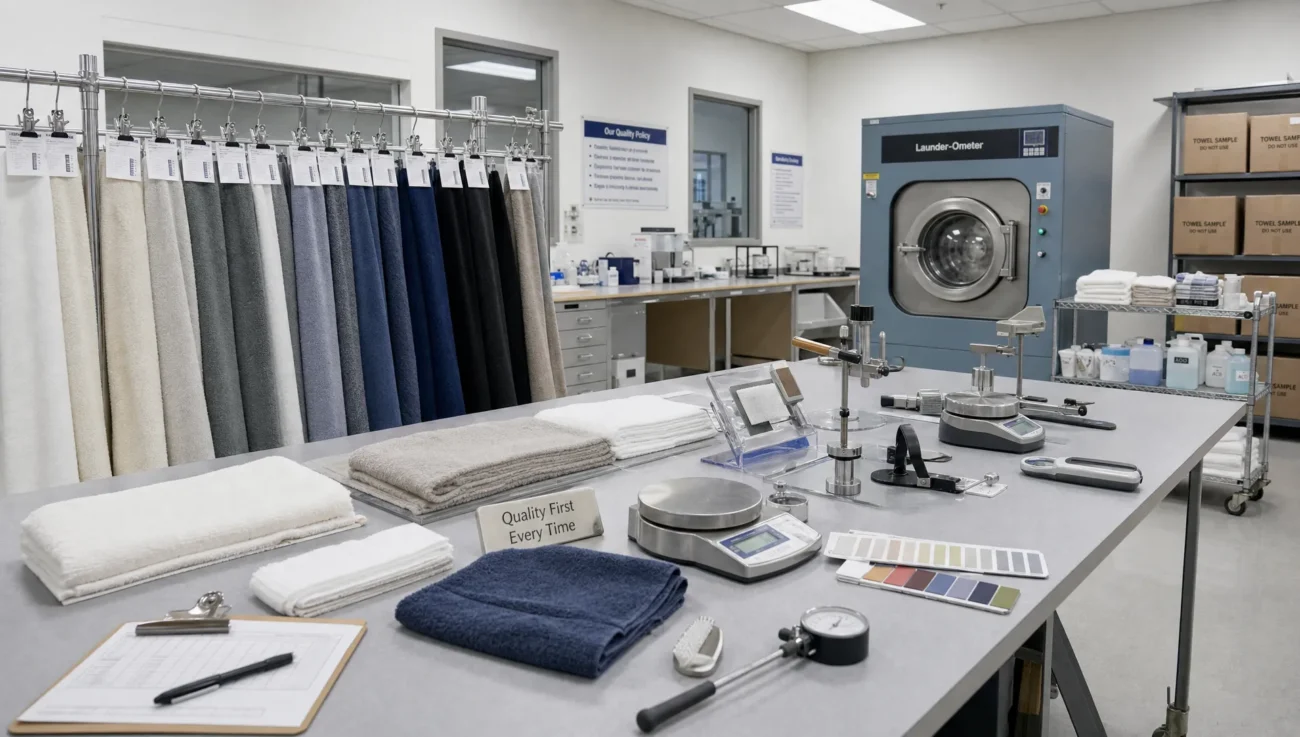
Bulk towel sourcing becomes expensive when buyers compare only price, color and a broad GSM range. A towel that looks competitive on a quote can fail after washing, feel rough in guest rooms or create problems at customs because the labeling details were never agreed in writing.
For hotels, hospitality suppliers, wholesalers, distributors and private-label brands, wholesale linen towels should be compared through a complete technical specification sheet. That sheet is what turns a supplier quote into something measurable: fiber, construction, size, absorbency, shrinkage, colorfastness, packaging and export terms.
One clarification first: in textile procurement, “linen towels” may mean towels included in a hotel linen or home linen program. It does not always mean towels made from flax linen fiber. If you require true flax linen, cotton-linen blends or cotton terry towels for a linen program, the fiber composition must be stated clearly before sampling.
Start With the End Use, Not the Catalog Photo
A spa towel, a hotel bath towel and a retail bath sheet can all look similar in a photograph. Their specifications should not be the same. Before requesting prices, define the use case, laundering method and expected customer experience.
Hotels and rental laundries usually prioritize durability, controlled shrinkage, fast drying and consistent replacement batches. Retail brands may place more emphasis on hand feel, presentation, color range and packaging. Spas and gyms often need strong absorbency with lower drying times because towels cycle through laundry more often.
| Buying scenario | Priority specs to compare | Common risk if ignored |
|---|---|---|
| Hotel guest rooms | GSM, size stability, stitching, wash durability | Towels shrink, fray or feel thin after repeated laundering |
| Spa and wellness | Softness, absorbency, lint control, colorfastness | Premium feel drops quickly or colors bleed |
| Gym and salon | Fast drying, bleach tolerance if needed, bulk cost | Towels smell, fade or wear out too soon |
| Retail and private label | Fiber story, color consistency, labeling, packaging | Returns increase because product does not match brand promise |
| Distributor stock | Repeatability, carton packing, lead time, broad sizing | Reorders do not match the first shipment |
If your sourcing program includes sheets, pillowcases and towels together, align towel specifications with the broader wholesale hotel linen program so the full guest-room textile package feels consistent.
Fiber Composition: What Is the Towel Actually Made From?
Fiber content is the first line on the spec sheet because it affects absorbency, drying, softness, price and labeling. For terry towels, buyers commonly compare cotton, combed cotton, ring-spun cotton, zero-twist cotton, bamboo-cotton blends and cotton-poly blends for institutional use.
If you are sourcing true linen towels made from flax, expect a different hand feel and construction than plush terry cotton. Flax linen is valued for its texture, breathability and fast drying, but it is not normally identical to a thick hotel terry towel. Cotton terry is usually preferred for plush bath towels because the loop structure holds more water and gives a fuller feel.
Do not accept “premium cotton” or “soft linen towel” as a complete material description. Ask for fiber percentage by component. For example, the pile may be 100 percent cotton while the ground yarn includes a cotton-poly blend for strength. That difference can be acceptable for some institutional buyers, but it should not be hidden.
A good fiber specification should include:
- Exact fiber percentages, including pile and ground if different
- Yarn type, such as ring-spun, open-end, combed or zero-twist
- Whether the towel is terry, waffle, flat weave or velour
- Any certification requirement, such as OEKO-TEX, GOTS or recycled-content documentation, if applicable
Certifications should be verified with current certificate numbers and scope. A certificate for one factory, fiber or product category does not automatically cover every towel in a new order.
GSM and Weight: Useful, but Never Enough Alone
GSM means grams per square meter. It is one of the most common towel specs, but buyers often overuse it as a shortcut for quality. A 600 GSM towel can be excellent or disappointing depending on yarn, pile height, finishing and construction.
As a practical comparison, lower GSM towels usually dry faster and cost less per piece. Higher GSM towels often feel heavier and more luxurious, but they can take longer to dry and may increase laundry energy costs. The right GSM depends on the buyer’s business model.
| GSM range | Typical buyer use | What to check before ordering |
|---|---|---|
| 350 to 450 GSM | Gyms, salons, economy hospitality, promotional towels | Absorbency, lint level and edge strength |
| 450 to 550 GSM | Standard hotel and wholesale programs | Balance of softness, durability and drying time |
| 550 to 700 GSM | Premium hotel, spa and retail bath towels | Laundry drying time, post-wash weight and shrinkage |
| 700 GSM and above | Luxury bath sheets and premium retail collections | Bulkiness, shipping cost and storage requirements |
Always compare GSM with actual piece weight. Two towels with the same GSM but different dimensions will not weigh the same, and piece weight affects carton packing, freight cost and customer perception.
For bath towel programs, you can compare supplier quotes against commercial product expectations such as wholesale bath towels for hotels and bulk buyers before finalizing the technical sheet.
Size, Tolerance and Post-Wash Dimensions
Towel dimensions should be agreed in both inches and centimeters for international orders. This reduces confusion between buyers, merchandisers, factories and freight teams.
The key question is not only “What is the cut size?” It is “What size will the towel be after washing?” Cotton and linen textiles can shrink. Professional buyers specify acceptable tolerance before production, then test samples after washing.
| Towel type | Common starting size in inches | Approximate metric size | Buyer note |
|---|---|---|---|
| Washcloth | 12 x 12 or 13 x 13 | 30 x 30 or 33 x 33 cm | Check edge durability because small towels are washed frequently |
| Hand towel | 16 x 28 or 16 x 30 | 40 x 70 or 40 x 76 cm | Useful for hotel rooms, gyms and retail sets |
| Bath towel | 27 x 52 or 27 x 54 | 68 x 132 or 68 x 137 cm | The most common bulk hospitality category |
| Bath sheet | 35 x 60 or 35 x 70 | 89 x 152 or 89 x 178 cm | Compare weight and carton volume carefully |
| Pool towel | 30 x 60 or larger | 76 x 152 cm or larger | Colorfastness, pile strength and laundering matter more |
Dimensions vary by market. A US retailer, German hotel group, Australian distributor and Japanese hospitality buyer may all use different preferred sizes. Put the exact size and tolerance into the purchase order rather than relying on local assumptions.
Construction Details That Affect Durability
Construction is where many towel quotes stop being comparable. One supplier may quote a heavier towel with weak edges, while another offers slightly lower GSM with stronger yarn and better stitching. The second option may perform better after repeated commercial washing.
Compare the following construction details before placing a bulk order:
- Loop type and pile height, which affect absorbency and plushness
- Terry density, which affects hand feel and water pickup
- Border style, including dobby, cam border or jacquard
- Hem width and stitching density
- Selvedge quality and side seam strength
- Whether the towel is yarn-dyed, piece-dyed, reactive-dyed or vat-dyed
For private-label programs, construction also affects brand identity. A jacquard logo, dobby border or custom stripe must be engineered into the towel rather than added as an afterthought. If a branded woven design is part of your plan, it may help to review how buyers evaluate jacquard towel manufacturers for private labels before approving artwork.
Absorbency, Drying Time and Softness
Absorbency is not the same as softness. A towel can feel soft in a showroom because of finishing chemicals, yet absorb poorly during first use. Another towel can absorb well but feel too dry or harsh for a premium hotel room.
Ask your supplier whether the towel has been treated for hydrophilicity, and test it after washing. Many buyers request a pre-production sample, wash it several times and then compare absorbency, lint and hand feel. This is more reliable than approving a sample straight out of the finishing line.
Drying time matters for hotels, gyms and laundries because it affects energy use, turnaround speed and towel availability. A very heavy towel may delight guests but slow down operations. That tradeoff should be made consciously, not discovered after the first container arrives.
Color, Design and Guest-Room Coordination
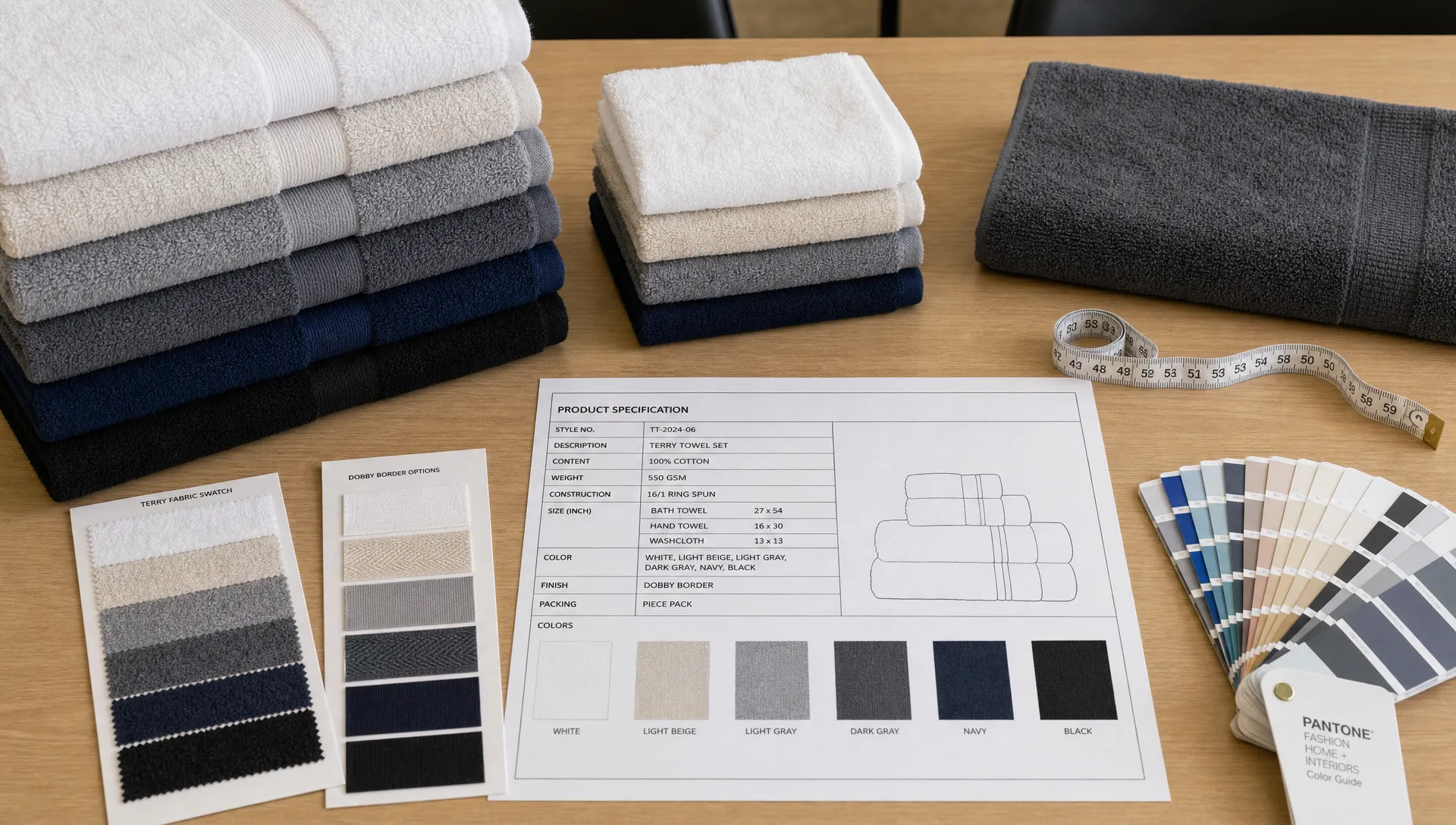
White remains common in hotels because it signals cleanliness and simplifies laundry control. Retail brands, spas and resorts often use color to create a more distinctive experience. In either case, color should be specified using a recognized reference, such as Pantone, a lab dip or an approved physical sample.
Color consistency is especially important across repeat orders. A slight shade difference may be acceptable for some distributor stock, but it can be a problem for a hotel chain or retail shelf where old and new inventory sit together.
Design coordination is broader than the towel itself. Hospitality buyers often compare textiles with room materials, bathroom finishes, amenities and lighting. For properties refreshing guest spaces, curated sources for modern designer lighting for hospitality interiors can be useful when textile colors and room ambiance need to work together.
For dyed towels, request colorfastness results for washing and rubbing. For pool, spa or salon towels, ask whether the color is suitable for exposure to chlorine, cosmetics or oils if those conditions apply. Do not assume a standard dyed towel can handle every chemical environment.
Shrinkage, Lint and Wash Performance
A towel should be evaluated after laundering because the guest, spa member or retail customer experiences the washed product. Bulk buyers should define a wash test protocol during sampling. Use the same detergent type, temperature and drying method that the towel will face in real use whenever possible.
Shrinkage affects size, shelf presentation and weight perception. Lint affects laundry efficiency, guest satisfaction and product appearance. Excessive lint in the first wash may be manageable, but ongoing linting usually points to yarn, construction or finishing problems.
| Performance area | Common test reference to discuss | Why it matters |
|---|---|---|
| Fabric mass | ASTM D3776 or ISO 3801 | Confirms GSM and helps compare quotes fairly |
| Dimensional change | AATCC TM135 or ISO 6330 wash procedure | Shows shrinkage after washing and drying |
| Absorbency | ASTM D4772 or AATCC TM79 | Helps verify real water pickup performance |
| Colorfastness to washing | AATCC TM61 or ISO 105-C06 | Reduces risk of fading or bleeding |
| Colorfastness to rubbing | AATCC TM8 or ISO 105-X12 | Checks dry and wet crocking risk |
| Breaking strength | ASTM D5034 or suitable textile method | Supports durability comparison for institutional use |
You do not need every test for every order. A small promotional towel program may not justify the same lab package as a multi-country hotel rollout. The key is to agree on the methods that match your risk.
Labeling and Compliance for International Buyers
A correct towel spec is not only about performance. It also supports legal labeling and smoother import. Buyers in the USA, Canada, the EU, the UK, Japan, Australia, South Africa and other markets should check destination requirements before production.
Common documentation and labeling points include fiber content, country of origin, care instructions, importer or distributor details, size, barcode requirements, carton marks and packing lists. Retail programs may also need hang tags, insert cards, polybag warnings or multilingual labels.
Restricted substance compliance should be treated seriously. If your market requires testing for azo dyes, formaldehyde, heavy metals, PFAS or other restricted substances, state the requirement in the purchase order and request test reports from relevant accredited labs. Avoid vague statements such as “export quality” because they do not define compliance.
Packaging, Carton Specs and Presentation
Packaging changes the landed cost and the customer experience. A hotel may prefer simple bulk cartons with inner polybags, while a retail buyer may require belly bands, kraft boxes, barcode stickers or custom inserts. A distributor may prioritize carton strength and pallet efficiency.
Ask for carton dimensions, pieces per carton, gross weight, net weight and cubic meters. These figures matter when comparing freight quotes. A towel that is cheaper per piece can become more expensive after shipping if it is packed inefficiently.
For private-label towels, agree on label placement, artwork files, care label wording, barcode format and packaging material before sampling. Packaging should be reviewed with the towel sample because color, fold, label and presentation work together.
MOQ, Lead Time and Repeat Order Consistency
Minimum order quantity is not just a supplier policy. It is linked to yarn purchasing, dyeing, loom setup, labeling, packaging and export packing. A custom color, jacquard pattern or private-label package usually requires a higher MOQ than a stock white towel.
Lead time should be split into stages: sampling, lab dip approval, bulk production, inspection, packing, documentation and shipping. Buyers should also ask how the supplier controls repeat orders. For hotels and distributors, consistency between the first shipment and reorder is often more important than achieving the absolute lowest first-order price.
A reliable manufacturer should be able to explain how raw material lots, dye lots, production records and inspection reports are controlled. If you plan to visit or audit a supplier, use a structured checklist like the one in this guide on what buyers should check at a towel factory in Pakistan.
Price Comparison: Move From Unit Cost to Landed Cost
The lowest FOB price is not always the lowest total cost. Wholesale towel buyers should compare landed cost per usable towel after accounting for shipping, duty, shrinkage, rejects, replacements and laundry life.
A stronger towel that costs slightly more can be cheaper over time if it lasts longer and creates fewer complaints. A lighter towel can be the smarter choice if it meets guest expectations, dries faster and reduces freight cost. The right decision depends on your operational model.
A useful cost comparison includes the quoted price per piece, currency, Incoterms, packing quantity, carton CBM, estimated freight, duty assumptions, inspection cost, testing cost and expected usable life. For multi-country buyers, keep separate landed cost models for each destination because duties, taxes and freight lanes differ.
Wholesale Linen Towels Spec Sheet Checklist
Before approving production, bring every important variable into one document. This prevents confusion between sales teams, merchandisers, production managers and quality inspectors.
| Spec category | What to define before bulk order |
|---|---|
| Product type | Bath towel, hand towel, washcloth, bath sheet, pool towel or towel set |
| Fiber | Exact composition by percentage, including pile and ground if relevant |
| Yarn | Ring-spun, combed, open-end, zero-twist or specified alternative |
| Construction | Terry, waffle, velour, dobby, jacquard or other weave details |
| GSM and piece weight | Target GSM, weight per piece and acceptable tolerance |
| Size | Cut size, finished size and post-wash tolerance |
| Color | White, dyed color reference, lab dip or approved standard sample |
| Performance | Absorbency, shrinkage, colorfastness, lint and strength expectations |
| Branding | Woven label, care label, embroidery, jacquard logo or private-label packaging |
| Packing | Pieces per carton, inner packing, carton marks, barcode and pallet plan |
| Compliance | Fiber label, care label, country of origin, restricted substance testing and certificates |
| Logistics | MOQ, lead time, Incoterms, port, documents and inspection plan |
This checklist also makes supplier quotations easier to compare. If two suppliers are not quoting the same spec, the lower price may not represent better value.
Questions to Ask Before You Confirm the Order
Once samples look acceptable, procurement teams should still ask direct questions before issuing a purchase order. The answers reveal whether the supplier understands bulk consistency, not just sample development.
Ask who controls yarn sourcing, dyeing, weaving, stitching, finishing, inspection and packing. Confirm whether the sample was made on the same construction planned for bulk. Request pre-shipment inspection criteria and clarify how defects will be handled. For custom packaging, ask for a mockup or photo approval before full packing begins.
For export orders, confirm commercial invoice details, packing list format, HS code guidance, certificate of origin needs and any buyer-specific documentation. A manufacturer experienced in global export can help organize these steps, but the importer remains responsible for checking requirements in the destination market.
Frequently Asked Questions
What GSM is best for wholesale linen towels? The best GSM depends on use. Hotels often choose a mid-weight towel that balances softness, durability and drying time, while luxury retail or spa programs may prefer a heavier towel. Always compare GSM with yarn, construction, size and wash performance.
Are linen towels the same as cotton terry towels? Not always. “Linen towels” can mean towels in a hotel linen program, or towels made from flax linen fiber. Cotton terry towels are more common for plush bath use, while true linen towels usually have a flatter, faster-drying texture.
What should buyers test before placing a bulk towel order? Buyers should test absorbency, shrinkage, colorfastness, lint, stitching and overall hand feel after washing. For larger programs, lab testing through recognized methods can reduce risk before production.
How do I compare towel quotes from different suppliers? Use the same spec sheet for every supplier. Include fiber, yarn, GSM, size, construction, color, packaging, performance tests, MOQ, Incoterms and carton details. Without the same spec, price comparisons are unreliable.
Can wholesale linen towels be private labeled? Yes, many towel programs can include woven labels, care labels, jacquard designs, embroidery, custom packaging and carton marks. The exact options depend on the construction, MOQ and supplier capability.
Build a Towel Spec That Protects Your Order
Wholesale towel buying is easier when every quote is tied to measurable specifications. Fiber, GSM, construction, size stability, absorbency, packaging and compliance all affect the final result.
Extreme Towel supports bulk towel and hotel linen sourcing for hospitality brands, wholesalers, distributors and private-label customers, with OEM manufacturing, quality control inspections, custom packaging and global export support. If you are preparing a new towel program, start with a clear specification sheet, approve washed samples and compare suppliers on total value rather than unit price alone.