Choosing the right manufacturing partner can shape everything about a bedding brand, from product reviews and repeat orders to margins and delivery reliability. For retailers, hospitality suppliers, distributors and ecommerce brands, the best private label bedding manufacturers are not simply the lowest bidders. They are the partners who can translate your product idea into consistent, compliant and market-ready bedding at scale.
A strong supplier should help you answer practical questions before production starts: Which fabric fits your customer segment? What level of customization is realistic for your order size? How will quality be checked before shipment? What packaging, labeling and export support are included?
This guide walks through the key criteria to evaluate before choosing a private label bedding manufacturer, with a focus on B2B buyers sourcing bedding for retail, wholesale or hospitality channels.
Start With Your Bedding Brand Positioning
Before contacting factories, define the product and customer you want to serve. A luxury hotel sheet program, a bamboo bedding line for ecommerce and a value-focused retail bedding set all require different specifications, tolerances and packaging decisions.
Start by documenting the basics in a clear product brief. This does not need to be complicated, but it should give suppliers enough information to quote accurately and identify possible production challenges.
| Product decision | What to clarify before sourcing |
|---|---|
| Target customer | Hotel, retail store, online brand, wholesaler, spa or distributor |
| Product type | Sheet sets, duvet covers, pillowcases, mattress protectors, throws or coordinated bedding sets |
| Fabric direction | Cotton, bamboo viscose, blended fabric, microfiber or another material |
| Feel and finish | Crisp, silky, breathable, brushed, sateen, percale or hotel-style finish |
| Size range | Twin, full, queen, king, California king or custom hospitality sizes |
| Branding | Woven labels, printed labels, care labels, branded packaging or carton markings |
| Sales channel | Ecommerce, hotel supply, retail shelf, wholesale distribution or private-label program |
The more precise your brief, the easier it becomes to compare suppliers fairly. If one manufacturer quotes on a basic sheet set and another quotes on premium fabric, custom packaging and export preparation, the numbers will not mean the same thing.
Confirm Their Real Manufacturing Capabilities
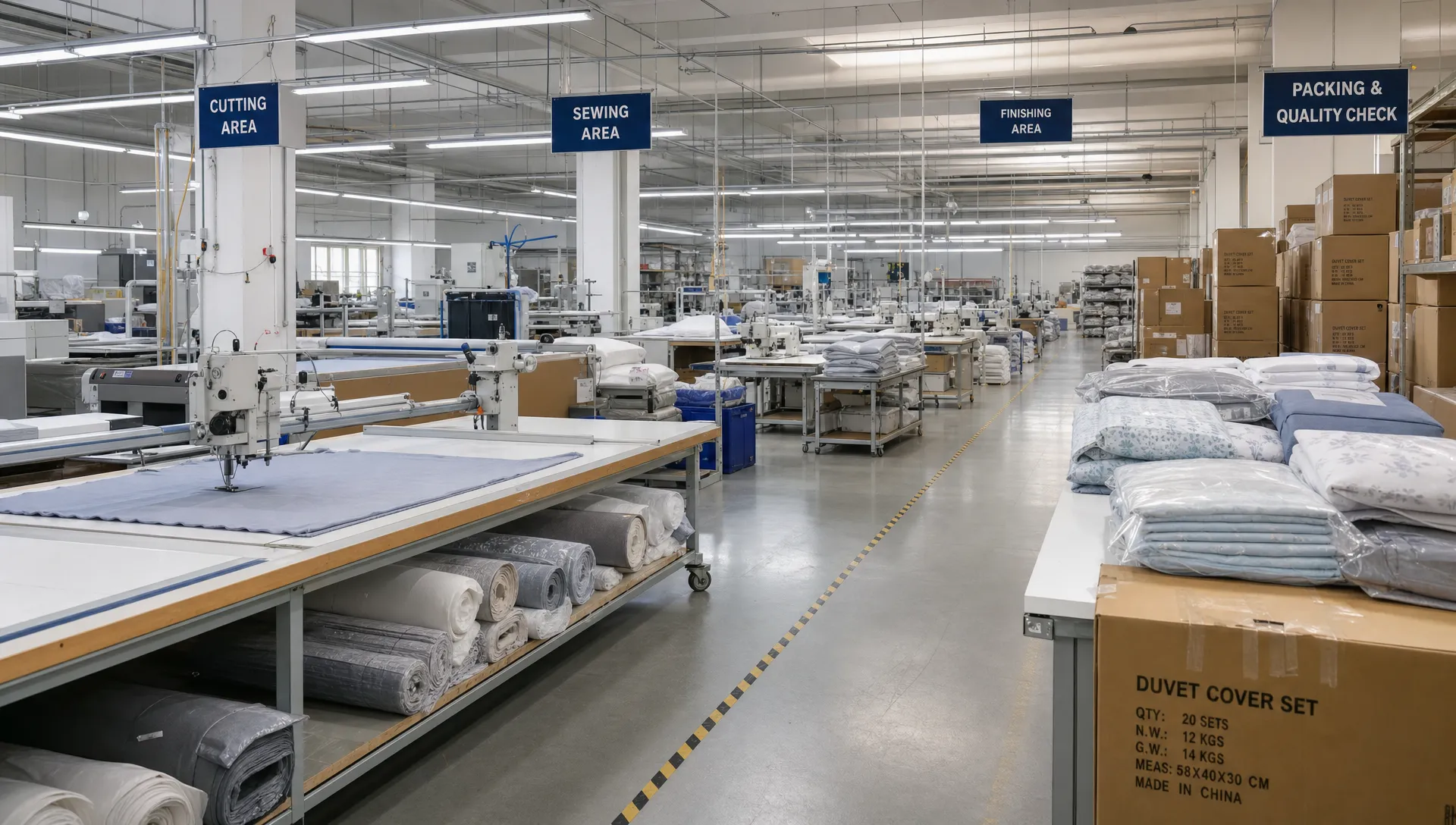
Many companies describe themselves as bedding suppliers, but their actual role can vary. Some are direct manufacturers with stitching, cutting, finishing and quality control processes. Others act as trading companies or sourcing agents. Neither model is automatically wrong, but you need to know who is responsible for production, quality and communication.
Ask whether the supplier manufactures in-house, outsources part of the work or coordinates multiple production units. For private label bedding, this matters because your brand identity depends on repeatable specifications. A factory that controls more of the process may be better positioned to maintain consistency across repeat orders.
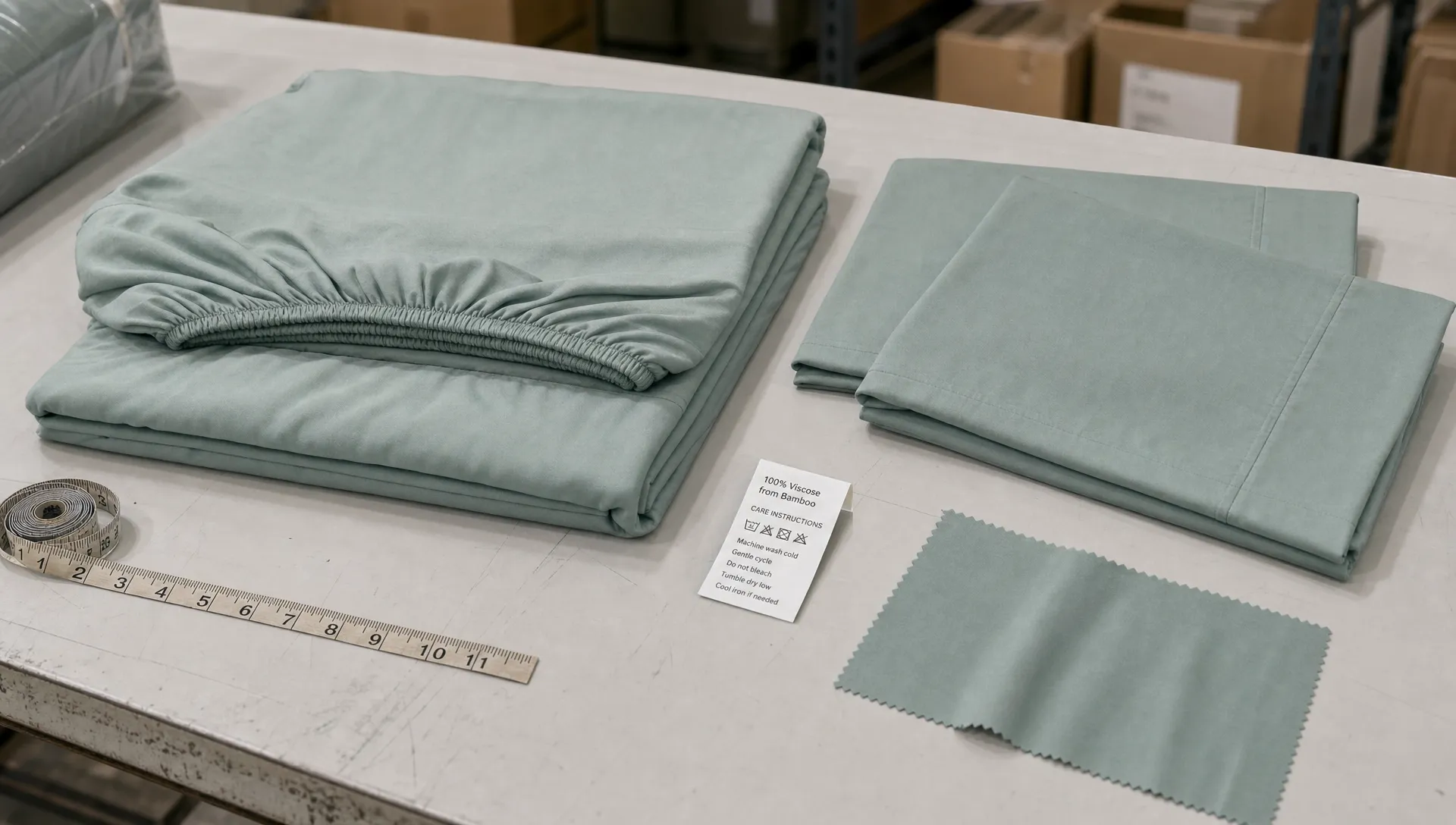
You should also confirm whether the manufacturer can support the specific product category you plan to sell. Bedding is a broad category. Bamboo bed sheets, hotel linen, duvet covers and decorative bedding sets each have different material sourcing and finishing requirements. For example, if your product concept is built around bamboo bedding, it makes sense to review a supplier’s experience with bamboo bed sheet manufacturing rather than treating all sheet producers as interchangeable.
For hospitality buyers, durability and laundering performance are often more important than retail presentation. In that case, compare suppliers based on their experience with bulk hotel programs and practical fabric options, such as the type of specifications outlined for wholesale hotel linen.
Evaluate Fabric Knowledge, Not Just Fabric Options
A capable manufacturer should do more than list materials. They should be able to explain how fabric choice affects comfort, durability, shrinkage, care instructions and cost.
For example, bamboo-derived fabrics are often valued for softness and drape, but buyers still need clarity on yarn quality, weave, finishing and labeling requirements. Cotton bedding can range from basic to luxury depending on staple length, yarn count, construction and finishing. Microfiber may suit some price-sensitive programs, but it will not deliver the same customer perception as premium natural or regenerated fibers.
When comparing private label bedding manufacturers, ask how they recommend fabric for different end uses. A good supplier will help you avoid mismatches, such as using a fabric that feels good in a sample but does not perform well after repeated hotel laundering or long-distance shipping.
Useful questions include:
- Which fabric constructions do you recommend for our price point and market?
- How do you test shrinkage, colorfastness and seam strength?
- Can you match a reference sample or develop a custom hand feel?
- What finishing options are available for softness, appearance and durability?
- Are fabric test reports available when required by the buyer?
A manufacturer that can explain tradeoffs clearly is usually a safer partner than one that simply says yes to every request.
Check Compliance, Certifications and Labeling Support
Compliance is not the most exciting part of product development, but it protects your brand. Bedding may need to meet textile labeling, fiber content, country of origin, safety and restricted substance requirements depending on the market where you sell.
For U.S. buyers, the Federal Trade Commission textile labeling rules are a useful reference for fiber content, country of origin and manufacturer or dealer identity requirements. For chemical safety and consumer confidence, certifications such as OEKO-TEX Standard 100 can help indicate that textile components have been tested for certain harmful substances.
If you plan to market bedding with sustainability claims, be especially careful. Terms like eco-friendly, natural, organic and sustainable can carry legal and reputational risk if they are not supported. Ask the manufacturer what documentation they can provide and have claims reviewed for your target market.
At minimum, your supplier should be comfortable discussing:
- Fiber content and care labeling
- Country of origin marking
- Buyer-specific packaging and carton labels
- Restricted substance expectations
- Test reports or certificates when applicable
- Documentation needed for customs clearance
Do not assume that a factory automatically knows the rules for your market. The buyer remains responsible for selling compliant goods, so choose a manufacturer that can cooperate with your compliance process.
Request Samples That Prove Production Quality
Samples are one of the most important steps in choosing a private label bedding partner. A beautiful sample does not guarantee successful bulk production, but it gives you a starting point for evaluating construction, feel and communication.
There are usually three sample stages worth understanding. A development sample helps confirm the product concept. A pre-production sample confirms the exact materials, measurements, labels and packaging before mass production. A shipment or production sample helps verify that finished goods match what was approved.
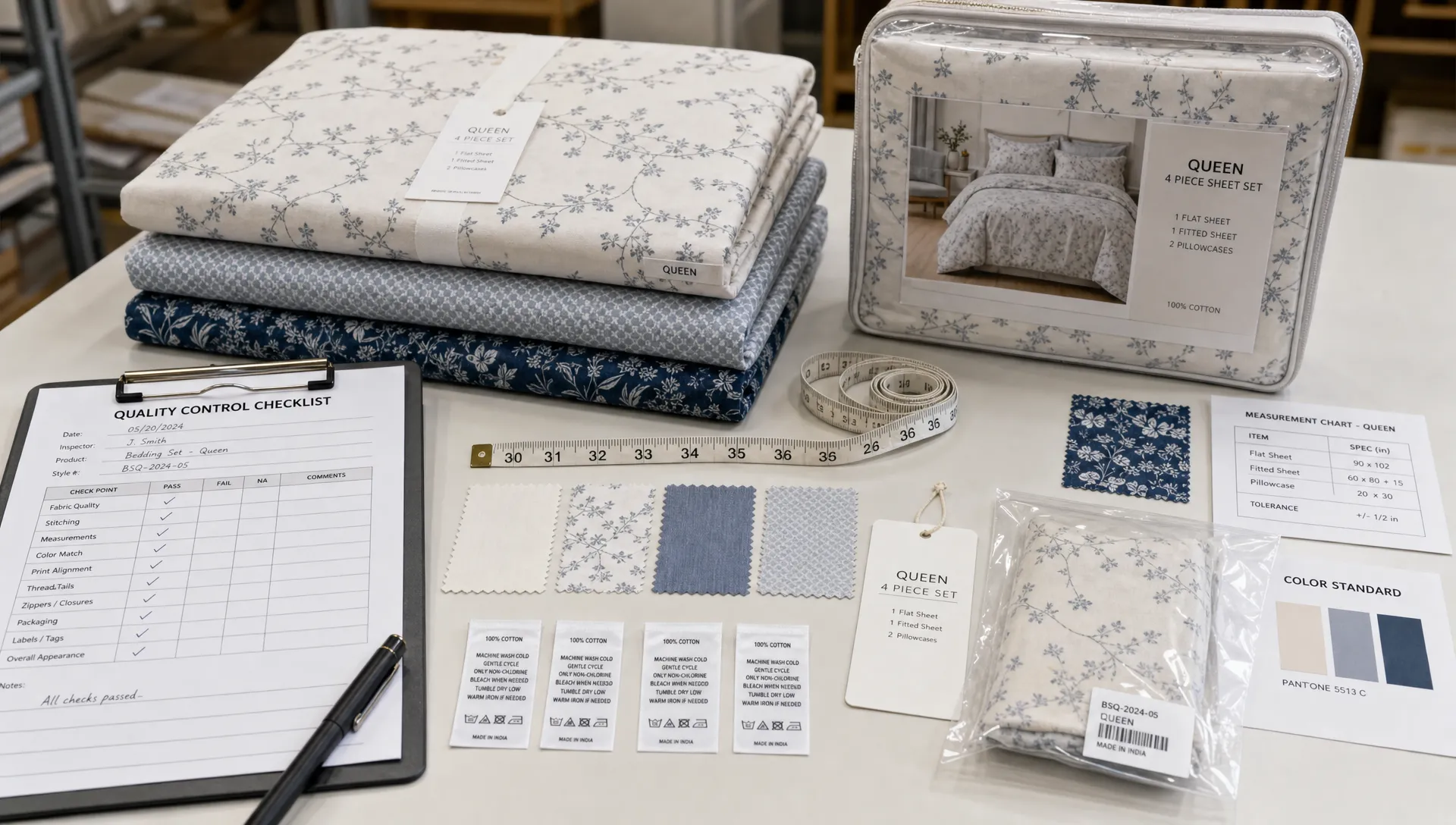
When reviewing bedding samples, look beyond first-touch softness. Check stitching consistency, seam strength, loose threads, shade variation, shrinkage after washing, label placement, packaging quality and measurements after laundering. If your product is designed for hotels or high-frequency use, wash testing is especially important.
Keep one approved sample as a control sample. This becomes the reference point for future production, quality checks and dispute resolution. If the factory changes fabric, thread, finishing or packaging without approval, the control sample makes the difference visible.
Compare MOQ, Lead Time and Scalability
Minimum order quantity matters, but it should not be evaluated in isolation. A low MOQ can help a new brand launch, but if the supplier cannot scale later, you may face delays or inconsistent product when demand grows. A higher MOQ may be acceptable for distributors or hotel suppliers if the pricing, quality and replenishment plan are strong.
Ask manufacturers how MOQ changes by fabric, color, size range, packaging and customization level. A standard white sheet set may be easier to produce in smaller quantities than a custom-dyed, fully branded bedding collection with multiple sizes and retail packaging.
Lead time also deserves careful discussion. Separate sample lead time, material sourcing time, production time, inspection time and shipping time. If a supplier gives one broad date without explaining what it includes, you may run into surprises later.
A reliable manufacturer should help you plan around seasonal demand, reorder cycles and shipping deadlines. For ecommerce brands, this may mean avoiding stockouts. For hospitality buyers, it may mean coordinating new property openings, renovation schedules or linen replacement cycles.
Look Closely at Quality Control Processes
Quality control should be built into production, not added as a quick visual check at the end. Bedding defects can be costly because they affect both product presentation and customer experience. A single issue, such as uneven sizing or poor stitching, may create returns across an entire batch.
Ask how the manufacturer checks incoming fabric, cutting accuracy, stitching, finishing, measurements, labeling and packing. For larger orders, many buyers use AQL sampling standards or third-party inspections, but the factory should still have internal checks before goods are presented for final approval.
| Quality checkpoint | Why it matters for bedding |
|---|---|
| Fabric inspection | Helps catch stains, weaving defects, shade variation and fabric flaws before cutting |
| Measurement checks | Reduces customer complaints about poor fit on mattresses, pillows or duvets |
| Stitching inspection | Protects durability, appearance and wash performance |
| Color and shade control | Keeps repeat orders consistent, especially for retail collections |
| Label verification | Reduces compliance risk and prevents packaging errors |
| Final packing inspection | Helps ensure the right size, quantity, SKU and carton information before export |
If a supplier resists inspection or cannot explain their quality process, treat that as a warning sign. Strong manufacturers are used to buyer approvals, documentation and quality expectations.
Understand Private Label Customization Options
Private label bedding is not only about putting your logo on a product. It includes the full presentation of your brand, from the fabric and stitching to labels, inserts, packaging and carton details.
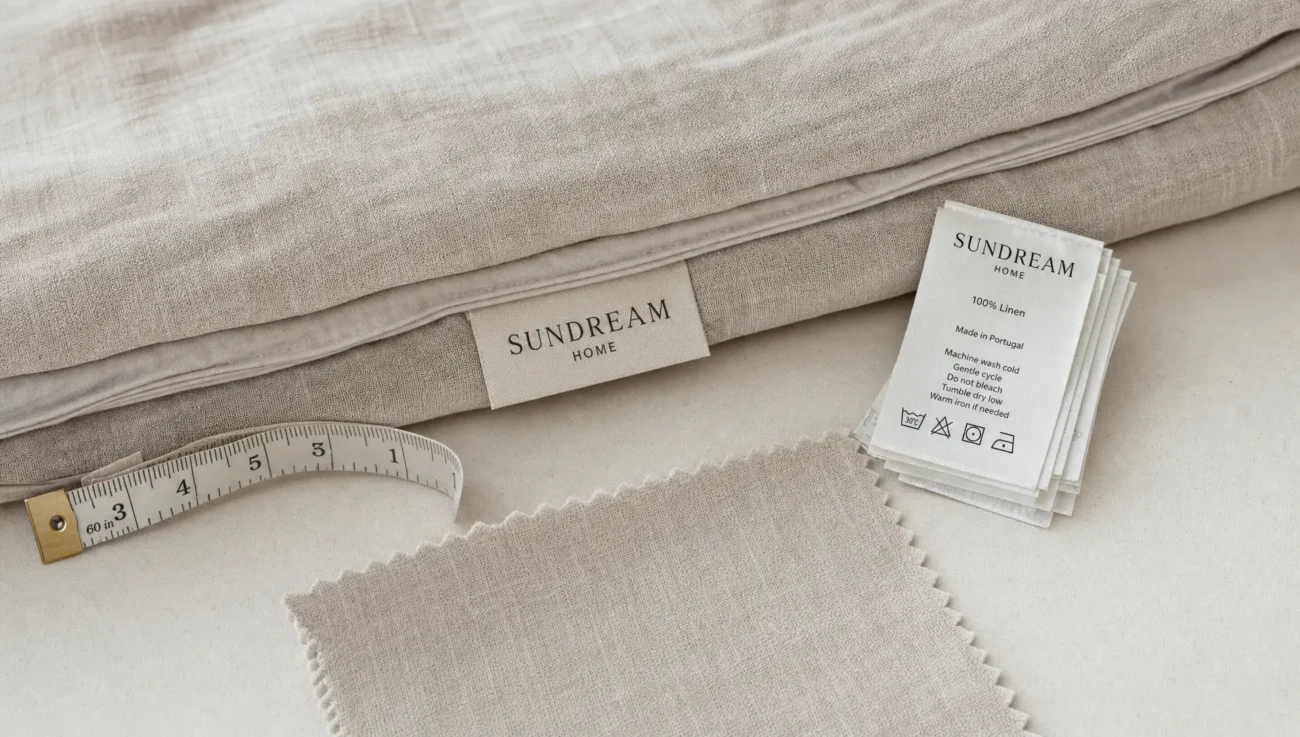
Common customization areas include woven brand labels, printed care labels, size labels, custom packaging, belly bands, inserts, barcodes and export cartons. Some brands also need custom colors, special size sets or coordinated collections across bedding, towels and robes.
If your brand plans to expand beyond bedding, choosing a textile manufacturer with broader private-label experience can reduce complexity. For example, brands that sell home textiles may also evaluate private-label towel programs, and Extreme Towel explains that side of production in its guide to private label towels for retail brands.
Be specific about what you expect the supplier to handle. A manufacturer may offer product labels but not retail-ready packaging. Another may support custom packaging but require buyer-provided artwork, barcode files or packaging dielines. Clarifying these details early prevents delays before shipment.
Analyze Total Cost, Not Only Unit Price
The cheapest quote is not always the most profitable option. Bedding has many cost drivers, and some are easy to overlook when comparing factories.
A low unit price may exclude packaging, testing, labeling, inland transport, inspection, export documentation or special finishing. It may also reflect a lower fabric quality than you expected. When comparing private label bedding manufacturers, ask for itemized quotes so you can see what is included and what is not.
| Cost factor | What to confirm |
|---|---|
| Fabric specification | Fiber content, construction, weight, weave and finish |
| Product making | Cutting, stitching, elastic, trims, labels and finishing |
| Packaging | Polybags, inserts, retail boxes, cartons, barcodes and carton marks |
| Sampling | Development samples, revised samples and courier charges |
| Testing | Required lab tests, certification documents or buyer-specific reports |
| Inspection | Internal QC, buyer inspection or third-party inspection coordination |
| Shipping terms | Incoterms, port handling, freight mode and export documentation |
For international buyers, Incoterms are especially important because they define which party is responsible for costs and risks at different points in the shipment. The International Chamber of Commerce maintains the official Incoterms rules used in global trade.
A slightly higher unit price from a more organized supplier may be better if it reduces defects, delays and communication problems. The goal is not to pay more without reason. The goal is to compare the real landed cost and the risk attached to each quote.
Review Export Experience and Documentation
If you are sourcing from overseas, export capability is a core selection factor. A manufacturer may produce good bedding but still struggle with documentation, packing discipline or shipment coordination.
Ask which markets the supplier regularly ships to and what documents they typically prepare. Depending on the order and destination, common export documents may include commercial invoices, packing lists, certificates of origin, bill of lading details and buyer-specific compliance documents.
You should also discuss carton packing standards. Bedding can be bulky, and poor packing may increase freight cost or create damage during transit. Confirm carton dimensions, carton weight, product folding method, moisture protection and labeling before production is complete.
Communication also matters during export. A good supplier should provide production updates, packing details and shipment information without forcing the buyer to chase every step.
Watch for Red Flags Before You Commit
Most sourcing mistakes leave clues early. Pay attention to how the supplier communicates before you send a deposit or confirm a purchase order.
Red flags include:
- Vague answers about fabric specifications or production location
- Unusually low prices without a clear explanation
- Refusal to provide samples before bulk production
- Poor understanding of labels, packaging or export requirements
- No documented quality control process
- Pressure to approve production before details are confirmed
- Inconsistent measurements, photos or product descriptions
- Slow replies when discussing technical points
A supplier does not need to be perfect, but they should be transparent. Problems happen in textile production. What matters is whether the manufacturer can identify issues early, communicate clearly and correct them before goods ship.
Ask Better Questions When Shortlisting Manufacturers
Good questions reveal how a manufacturer thinks. Instead of asking only “What is your best price?”, use questions that test capability, accuracy and reliability.
| Question to ask | What the answer tells you |
|---|---|
| Have you produced similar bedding for our market? | Shows relevant experience with your customer type and expectations |
| What fabric do you recommend for our target price and use case? | Tests technical knowledge and honesty about tradeoffs |
| What is included in your quotation? | Helps avoid hidden costs and unfair comparisons |
| Can you provide a pre-production sample before bulk production? | Confirms whether approvals are part of the process |
| How do you control shrinkage and measurement variation? | Reveals attention to practical bedding performance |
| What packaging options can you support? | Clarifies private-label readiness |
| How do you handle defects found during inspection? | Shows accountability and problem-solving approach |
| Which export documents can you prepare? | Confirms international shipping experience |
Take notes after each call or email exchange. The best supplier may not be the one with the most polished sales pitch. It is often the one that gives clear answers, asks practical questions and helps refine the product brief.
Build a Simple Supplier Scorecard
A scorecard helps remove emotion from the decision. After you receive quotes, samples and answers, compare each manufacturer across the same criteria.
You can score suppliers from 1 to 5 in areas such as product quality, fabric knowledge, customization, compliance support, MOQ fit, lead time, communication, export experience and total cost. Weight the categories based on your business model. A luxury bedding brand may give more weight to fabric and finishing, while a distributor may prioritize replenishment reliability and carton efficiency.
Do not rush the final decision after receiving one good sample. Confirm whether the supplier can reproduce that quality in bulk, communicate during production and support repeat orders. Private label success depends on consistency over time, not a single attractive prototype.
Frequently Asked Questions
What are private label bedding manufacturers? Private label bedding manufacturers produce bedding products that are sold under another company’s brand name. They may support custom fabrics, labels, packaging, sizing and bulk production depending on their capabilities.
How do I know if a bedding manufacturer is reliable? Review samples, ask about quality control, confirm export experience, check communication quality and request clear specifications in writing. A reliable manufacturer should be transparent about MOQ, lead times, materials and what is included in the quote.
What should I include in a bedding product brief? Include product type, fabric preference, size range, target market, quantity, branding needs, packaging requirements, quality expectations and destination market. A clear brief helps suppliers quote accurately.
Is the lowest-priced bedding supplier the best choice? Not usually. The lowest price may exclude key costs or reflect lower material quality. Compare total landed cost, sample quality, defect risk, packaging, compliance support and export reliability before choosing.
Can I start with a small private label bedding order? It depends on the manufacturer, fabric, customization level and product complexity. Standard products may allow lower MOQs than custom-dyed or heavily branded bedding programs. Always ask how MOQ changes by specification.
Choose a Manufacturer That Fits Your Brand, Not Just Your Budget
The right private label bedding manufacturer should understand your product goals, protect your specifications and support your growth beyond the first order. Look for clear communication, practical fabric guidance, reliable sampling, documented quality control and export experience.
Extreme Towel is a Pakistan-based textile manufacturer and exporter supporting custom OEM manufacturing, bulk production, private-label customization, quality control inspections, custom packaging and global export service for home textile and hospitality buyers. If you are developing a bedding line for retail, wholesale or hospitality, visit Extreme Towel to discuss your private label manufacturing requirements.