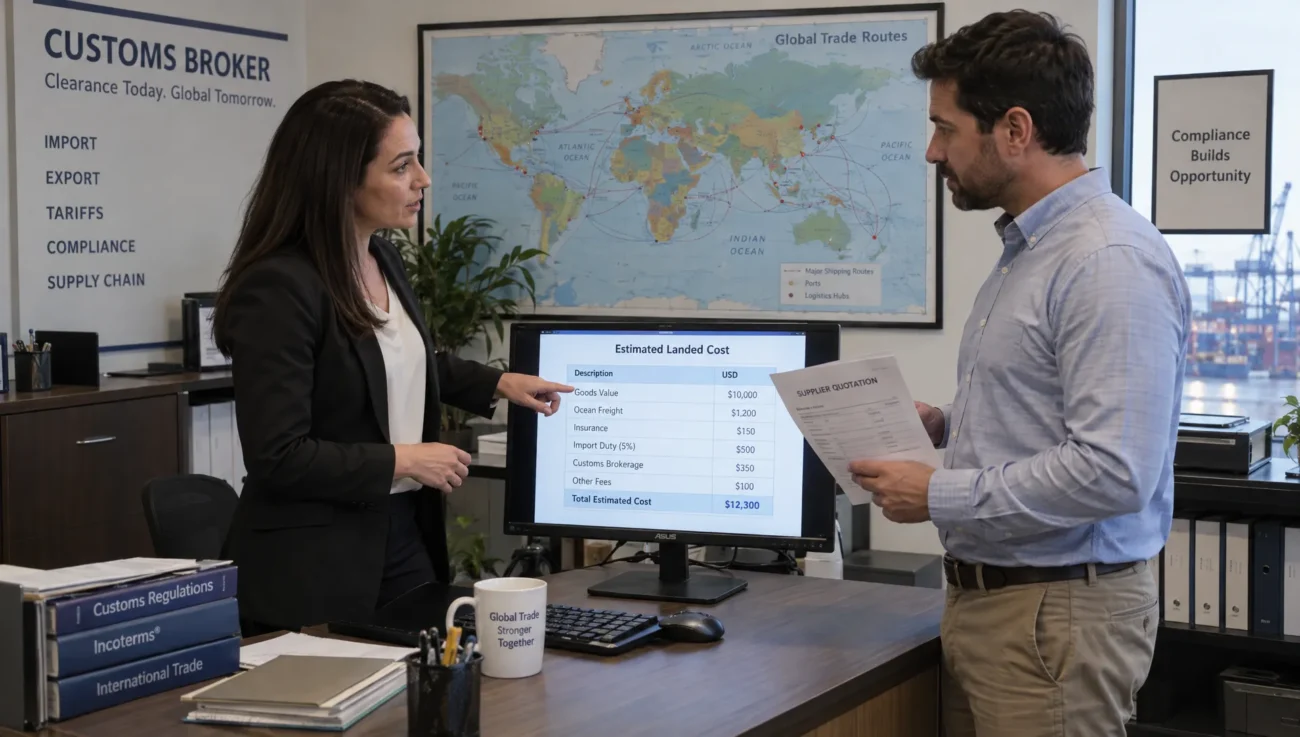
A factory quote is only the starting point when buying wholesale bed sheets. Your actual cost also depends on freight, customs duties, destination charges, currency conversion and the number of usable sets that reach your warehouse. A lower unit price can become the more expensive offer once those costs are included.
The most useful approach is to build a shipment-level worksheet, then divide the total by a clearly defined purchasing unit. This guide explains the calculation, shows a worked example and identifies the assumptions you should confirm before approving a bulk order.
Separate landed cost from cash required to import
Before comparing suppliers, calculate two totals:
Economic landed cost includes the product and the costs of getting it to your chosen destination, including duties and nonrecoverable taxes. For purchasing decisions, you may also include directly attributable inspection and payment costs. Your accountant should confirm how individual charges are treated in inventory accounting.
Import cash requirement includes those payments plus recoverable import taxes and any other upfront amounts you must fund. Recoverable VAT or GST can affect cash flow without becoming a permanent product cost, provided your business qualifies for recovery and holds the required documentation.
Use these formulas:
Economic landed cost = goods + transport + insurance + duties + clearance + destination delivery + other attributable costs + nonrecoverable taxes.
Cost per usable unit = economic landed cost ÷ usable units received.
Choose the endpoint explicitly. A shipment priced to the arrival port is not comparable with one priced through delivery to your distribution center.
Build a landed-cost worksheet for wholesale bed sheets
A reliable worksheet starts with consistent specifications, a named delivery point and clear responsibility for each charge. Work through the following inputs before inserting estimated costs.
Define exactly what one unit includes
“Per sheet,” “per pair” and “per set” are different purchasing units. A four-piece set containing a fitted sheet, flat sheet and two pillowcases cannot be compared directly with a single flat sheet.
Record the fiber composition, weave, finished dimensions, fitted-sheet pocket depth, component count and packaging format. Confirm whether labels, retail inserts and export cartons are included in the quoted price.
For wholesale bed sheets, size differences also affect fabric consumption, packing volume and freight allocation. A supplier’s “queen” designation may not match your destination market’s mattress dimensions. Establish measurements rather than relying on size names; this guide to specifying custom-size bed sheets explains the fit considerations behind that specification.
Keep separate worksheet lines for materially different SKUs. Otherwise, an average shipment cost can hide an unprofitable size or packaging configuration.
Match the quote to its Incoterm and named place
Ask for the trade term, named place or port and applicable version, such as “FCA [named location], Incoterms 2020.” The ICC’s Incoterms rules allocate specified transport obligations, costs and risks between buyer and seller. They do not replace the rest of your purchase contract.
EXW can leave the buyer responsible for collection and export arrangements. FCA generally includes delivery to the nominated carrier at the agreed point and seller-side export clearance. FOB applies to sea or inland waterway transport and places delivery on board the vessel at the named shipment port; FCA is often better suited to containerized movements.
With CIF, the seller pays specified freight and insurance to the destination port, but risk transfers earlier at shipment. CIF does not mean duty-paid warehouse delivery.
When comparing wholesale bed sheets, do not add freight again if it is already included in the quoted term. With DDP offers, confirm who will be importer of record, what taxes are included and whether your business will receive documents needed for any tax recovery.
Confirm customs classification, value and origin
Bed linen commonly falls within HS heading 6302, but that heading is not enough to establish the duty payable. The destination’s full tariff classification can depend on fiber composition, construction, printing and other product characteristics.
For US imports, consult the US International Trade Commission’s Harmonized Tariff Schedule. For EU destinations, the European Commission’s Access2Markets portal helps identify tariff and origin requirements. Have your broker confirm the applicable classification, additional measures and entry-date treatment before shipment.
Customs value is not automatically the invoice total or your complete landed cost. Depending on the destination’s rules, freight, insurance, packing, assists, royalties or other adjustments may affect the valuation.
For wholesale bed sheets exported from Pakistan, do not assume a preferential duty rate applies simply because the goods ship from Pakistan. Eligibility depends on the destination’s arrangement, qualifying origin rules and acceptable supporting evidence.
Ask your broker to confirm three separate items: the customs value, the applicable duty calculation and the import-tax base. VAT or GST may apply to a broader base than the goods invoice alone.
Collect the full logistics quote
Request shipment measurements based on the actual packing plan: carton count, dimensions, gross weight, net weight and pallet details where applicable. Freight estimates based only on order quantity are difficult to verify.
Ocean less-than-container-load shipments can carry minimum charges and destination handling fees. Full-container shipments have different economics, while air freight may be billed using actual or volumetric weight under the carrier’s rules.
A logistics budget for wholesale bed sheets should include origin charges not covered by the supplier, main carriage, cargo insurance, destination handling, customs brokerage and final delivery. Ask whether unloading, appointments or warehouse receiving services cost extra.
Separate predictable charges from contingencies such as examinations, storage, demurrage and detention. These are not interchangeable fees, and their triggers depend on the shipment and provider. Keep a contingency allowance in your planning model without presenting it as a confirmed invoice amount.
Worked example: from factory price to usable-set cost
The following figures are illustrative budgeting assumptions, not current freight quotes or tariff rates. The example uses USD throughout and ends at the buyer’s warehouse.
Assume an order of 2,000 four-piece sets at $10 per set, quoted FOB at the named shipment port. Origin costs covered by that quote are already included. For this hypothetical destination, customs value includes the goods, ocean freight and insurance, with no other valuation adjustments.
Calculate the shipment total
| Cost item | Calculation or assumption | Amount |
|---|---|---|
| Goods, including agreed packaging | 2,000 sets × $10 | $20,000 |
| Ocean freight | Illustrative shipment quote | $2,600 |
| Cargo insurance | Illustrative premium | $100 |
| Import duty | 8% × $22,700 customs value | $1,816 |
| Destination terminal and documentation charges | Illustrative quote | $650 |
| Customs brokerage | Illustrative quote | $250 |
| Delivery to warehouse | Illustrative quote | $500 |
| Third-party inspection | Illustrative cost | $300 |
| Bank and currency-conversion costs | Illustrative cost | $200 |
| Total economic landed cost | Excludes recoverable import taxes | $26,416 |
The $22,700 customs value is a calculation base, not an additional expense. Adding it to the worksheet total would double-count goods, freight and insurance.
This model assumes no nonrecoverable import taxes. If any apply, add them. Put recoverable import taxes in a separate cash-flow row using the destination’s actual rules and your business’s eligibility.
Divide by usable sets, not just ordered sets
For this order of wholesale bed sheets, the cost per ordered set is:
$26,416 ÷ 2,000 = $13.21 per set, rounded.
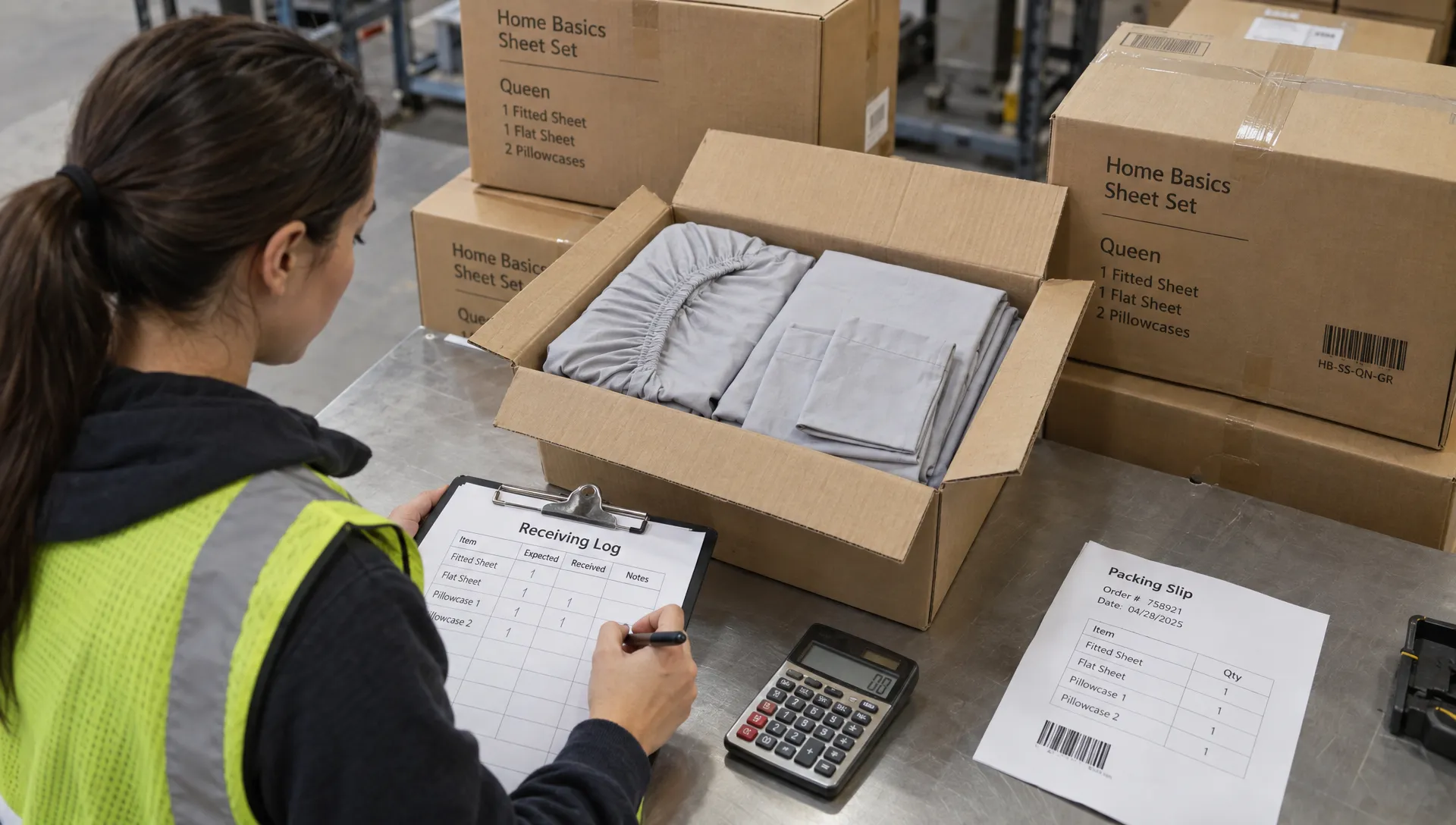
Now assume receiving inspection identifies 40 unusable sets, with no supplier credit, replacement or salvage recovery. That leaves 1,960 usable sets:
$26,416 ÷ 1,960 = $13.48 per usable set, rounded.
The usable-set figure is the more relevant input for pricing and margin decisions. Do not treat the assumed rejection quantity as an industry benchmark. Use your inspection results or a clearly labeled planning assumption, then update the calculation when claims are resolved.
Handle currency and mixed-SKU shipments carefully
Use the exchange rate you can actually obtain
If your supplier invoices in USD but you sell in euros, Canadian dollars or another currency, convert costs using your bank’s executable rate or your contracted hedge rate. A public reference rate may exclude the spread and transaction fees you will pay.
For deposits and balances paid on different dates, record each payment at its actual rate. Before payment, model an adverse exchange-rate scenario so that your margin does not depend on an optimistic conversion assumption.
Keep the customs conversion rate separate where local rules require one. The exchange rate used for customs assessment may differ from your bank’s settlement rate.
Allocate shared costs using a defensible basis
When wholesale bed sheets share a shipment with towels or other textiles, do not allocate every charge equally across units. Different products consume different amounts of shipping capacity.
Allocate volume-driven freight using packed cubic volume where appropriate. Use chargeable weight for weight-driven services, customs value and applicable rates for duties, and direct attribution for SKU-specific inspection or labeling costs. Allocate fixed brokerage charges consistently using a documented method.
Check that all SKU allocations add back to the shipment total. This simple reconciliation prevents costs from disappearing between the freight invoice and your product-margin report.
Stress-test the calculation before approving the order
A landed-cost estimate should show how much room the order has for changes, not just produce one attractive number.
Using the worked example, assume an additional $1,000 in freight also increases the hypothetical customs value by $1,000. At the example’s 8% duty rate, that adds another $80 in duty. The total increase is therefore $1,080, excluding any recoverable-tax cash-flow effect.
| Scenario | Economic landed cost | Usable sets | Cost per usable set |
|---|---|---|---|
| Original example | $26,416 | 1,960 | $13.48 |
| Freight increases by $1,000, plus $80 duty | $27,496 | 1,960 | $14.03 |
| Unusable quantity increases to 100 sets | $26,416 | 1,900 | $13.90 |
| Both changes occur | $27,496 | 1,900 | $14.47 |
For wholesale bed sheets sold through retail or distribution, compare these outcomes with your net selling price after discounts. Selling fees, fulfillment, returns and overhead remain separate unless your model explicitly includes them.
Gross margin is not markup. At a 40% target gross margin, a $13.48 product cost implies a selling price of approximately $22.47 before other costs, calculated as $13.48 ÷ 0.60. Simply adding 40% would not produce a 40% gross margin.
Request the information that makes quotes comparable
Send suppliers and freight providers the same specification and delivery assumptions. A short, complete request is more useful than asking only for a “best price.”
Request these inputs:
- Product definition: SKU quantities, set components, fiber composition, construction, finished dimensions and packaging requirements.
- Commercial basis: Unit price, currency, Incoterm, named place, quote validity and payment schedule.
- Packing plan: Carton quantities, carton dimensions, gross weight and palletization where relevant.
- Customs information: Detailed product description, declared origin and available supporting documents, subject to broker verification.
- Logistics scope: Included and excluded charges, destination delivery point, transit assumptions and applicable free-time terms.
- Quality arrangements: Inspection scope, acceptance criteria and the process for handling shortages or rejected goods.
For wholesale bed sheets entering Canada, also resolve importer registration and clearance arrangements before booking. The guide to importing hotel linens into Canada without delays covers destination-specific preparation beyond this cost worksheet.
After delivery, replace estimates with actual invoices and receiving results. Record which assumptions changed so the next purchase uses better evidence.
Frequently asked questions
Does landed cost include import VAT or GST? Include nonrecoverable taxes in economic landed cost. Track recoverable taxes separately as a cash requirement, subject to your registration status, permitted use and documentation. Recovery is not automatic for every importer.
Is a duty-paid quote always cheaper? No. Compare the complete price, delivery scope, importer responsibilities and tax documentation. A DDP quote may simplify arrangements, but that alone does not establish a lower cost or guarantee that you can recover import tax.
Can I calculate cost using pieces instead of sets? Yes, provided the unit is consistent. For wholesale bed sheets sold as sets, set-level costing usually supports clearer pricing decisions. Individual component costs remain useful when selling replacements or comparing differently configured sets.
Should I use ordered quantity or received quantity? Use ordered quantity for an initial estimate, then reconcile against actual usable receipts. Account separately for shortages, rejected goods, supplier credits and replacements so neither losses nor recoveries are counted twice.
How often should I update the worksheet? Refresh it when specifications, packing, freight, exchange rates or customs treatment change. Recheck time-sensitive quotes before committing to the order and again before shipment where necessary.
Build your next order around a complete cost brief
Extreme Towel is a Pakistan-based manufacturer and exporter offering hotel linen production, private-label customization, OEM manufacturing and bulk orders. When discussing your requirements with Extreme Towel, provide the product specification, quantities, packaging requirements and destination, then request a clearly scoped quotation.
Combine that quotation with current broker and freight estimates. The purchasing decision should rest on the cost of a usable set at your warehouse, not the lowest number on the supplier’s price list.