Choosing a jacquard towel manufacturer for a private-label program is a different decision from buying generic stock towels. You are not only sourcing a towel, you are translating a brand identity into woven fabric that must look consistent across production runs, feel right to the end customer and arrive with the correct labeling, packaging and documentation.
For buyers in the USA, Canada, Europe, Japan, Australia and other export markets, the best supplier is rarely the one with the lowest opening price. A strong jacquard towel partner should understand yarn, loom setup, artwork conversion, color control, shrinkage, finishing, inspection standards and private-label presentation. The comparison process should help you separate true manufacturers from trading companies, sample-room promises from bulk-production reality and attractive photos from repeatable quality.
What Makes Jacquard Towels Different From Standard Towels
Jacquard towels use a woven design created directly on the loom. Instead of adding a logo after the towel is made, the pattern is built into the towel structure through controlled yarn placement. This gives private labels more design flexibility than a plain towel and a more integrated brand appearance than basic embroidery.
That difference also makes supplier selection more technical. A jacquard towel manufacturer must be able to interpret artwork, build weaving instructions, manage yarn colors, control pile height and maintain design clarity after washing. A complicated logo, tonal pattern or all-over design may look excellent on a digital mockup but lose definition if the loom setup, yarn count or color contrast is not right.
| Decoration method | Best use case | Key buying consideration |
|---|---|---|
| Jacquard weaving | Logos, borders, all-over patterns and premium private-label collections | Requires strong design conversion and loom capability |
| Embroidery | Small logos, monograms and hospitality branding | Adds texture but can affect softness if overused |
| Printing | Graphic beach towels or promotional designs | Requires attention to colorfastness and hand feel |
| Plain dyeing | Classic hotel, spa and retail basics | Relies heavily on material, GSM and finishing quality |
If your private label is building a signature towel collection, jacquard is often the better route because the design feels intentional rather than applied afterward. The tradeoff is that you need a manufacturer with deeper technical control.
Start With a Product Brief Before Comparing Suppliers
Many sourcing problems begin with vague inquiries. If you ask five factories for “custom jacquard towels,” you will likely receive five different interpretations. Some may quote different sizes, yarn qualities, GSM levels, packing methods or finishing processes, making the comparison almost useless.
Before you contact a manufacturer, prepare a clear product brief. It does not need to be overly complicated, but it should define the commercial and technical expectations.
A useful brief usually includes:
- Product type, such as bath towel, hand towel, beach towel, gym towel or hotel towel
- Size in centimeters or inches, with tolerance expectations if available
- Target GSM or weight range
- Fiber preference, such as cotton, organic cotton, bamboo blend or another material
- Jacquard design details, including logo files, pattern repeats, borders and color references
- Quantity by size, color and design
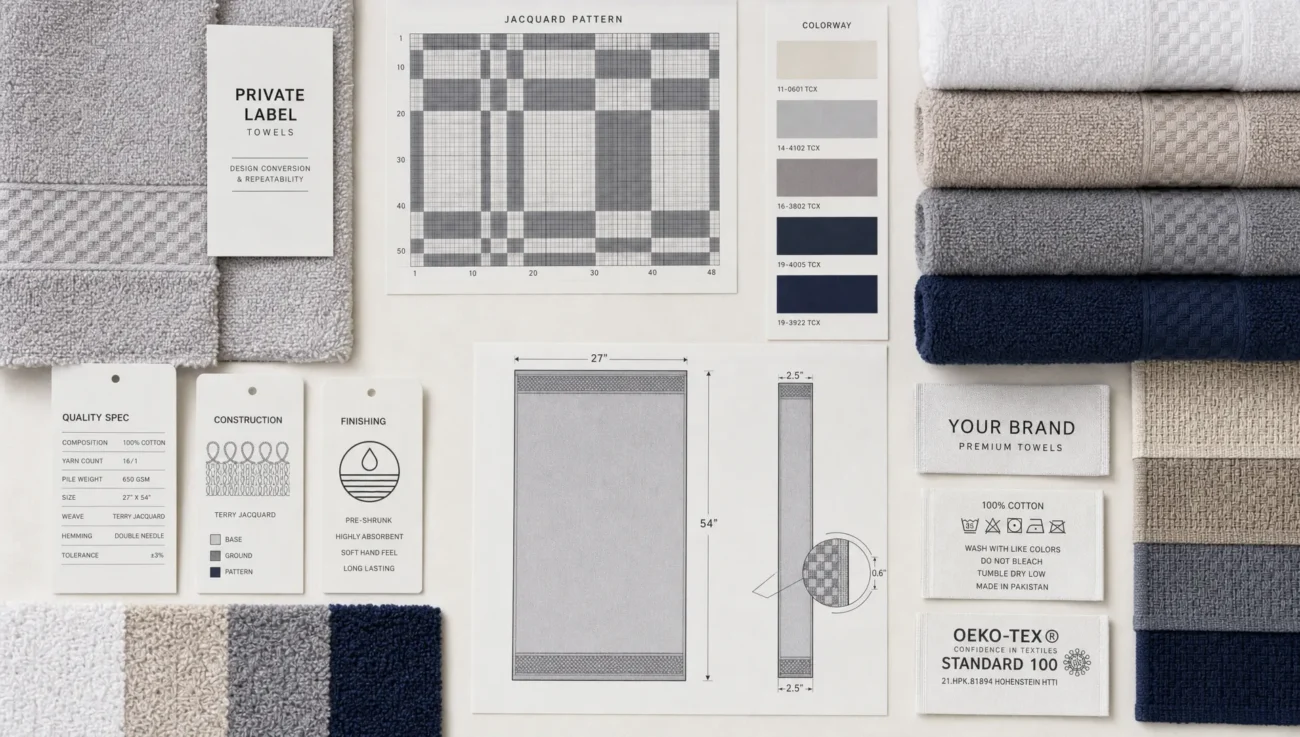
- Labeling needs, such as woven label, care label, hangtag or barcode sticker
- Packaging requirements, such as carton packing, retail band, polybag or custom packaging
- Destination market and required shipping terms
This brief helps serious suppliers quote accurately and reveals how well they understand private-label development. If a supplier gives a fast price without asking about construction, packaging, colors or artwork, they may be treating the order as a commodity rather than a branded product.
For a broader look at how private-label towel programs are structured, Extreme Towel’s guide to private label towels for retail brands is a helpful companion to this manufacturer comparison process.
Compare Real Weaving Capability, Not Just Product Photos
Product images are useful, but they do not prove manufacturing capability. A jacquard towel manufacturer should be able to explain what types of designs it can weave, what limitations apply and how it converts artwork into production-ready files.
Ask how the factory handles design development. A capable supplier should be comfortable discussing pattern scale, logo placement, border width, yarn colors, pile structure and the difference between high-contrast and low-contrast designs. They should also be able to tell you when a design needs simplification. This is not a weakness. It is a sign that the manufacturer understands how woven graphics behave in real terry fabric.
For private labels, repeatability matters as much as first-sample quality. If you launch a towel collection and reorder six months later, your customers expect the same color, feel, size and design definition. That requires controlled loom settings, documented specifications and a consistent yarn supply.
Questions worth asking include:
- Do you manufacture jacquard towels in-house or outsource weaving?
- What file formats do you need for artwork conversion?
- Can you produce borders, all-over patterns and logo jacquard designs?
- How do you manage color matching for dyed yarn or finished towels?
- Can you provide a pre-production sample before bulk weaving?
The answers should be specific. A vague “yes, we can do everything” is less useful than a clear explanation of what is possible, what affects price and what could affect lead time.
Evaluate Materials, GSM and Hand Feel Together
Private-label buyers often compare towels by GSM first. GSM matters, but it should not be the only quality marker. A towel with a high GSM can still feel harsh, dry slowly or shed lint if the yarn and finishing are poor. A well-made medium-weight jacquard towel can outperform a heavier towel if the cotton quality, pile structure and finishing are better suited to the product’s use.
Think about the customer and channel. A luxury hotel towel may prioritize plushness, absorbency and long service life. A beach towel may need a larger surface area, a strong design and quicker drying. A retail bath towel collection may need a balance of shelf appeal, softness, competitive pricing and reliable packaging.
| Product goal | What to compare | Why it matters |
|---|---|---|
| Premium bath towel | Cotton quality, pile height, GSM, softness after washing | Impacts customer perception and repeat purchases |
| Hotel towel | Absorbency, durability, edge stitching and laundering performance | Supports heavy-use hospitality environments |
| Beach towel | Design clarity, size, weight and drying behavior | Affects retail appeal and travel convenience |
| Spa towel | Softness, color consistency and clean finishing | Reinforces a premium guest experience |
| Promotional towel | Design visibility, cost control and packaging | Helps balance brand impact with budget |
Ask suppliers to provide full technical specifications with the sample, not just a photo or weight estimate. The sample should tell you the fiber composition, towel size, GSM, yarn details if available, color reference, finishing method and packing method. If you are comparing several suppliers, create one internal evaluation sheet so every sample is judged against the same criteria.
Review the Sampling Process Carefully
Sampling is where a jacquard towel manufacturer proves whether it can turn your concept into a market-ready product. Do not treat samples as a formality. A sample that looks close enough at first glance may reveal problems after washing, folding, packaging or side-by-side comparison with your target quality.
A professional process may include artwork review, digital mockup, lab dip or color reference approval, jacquard sample, pre-production sample and final bulk approval. Not every project needs every step, but custom private-label work benefits from documented approval points.
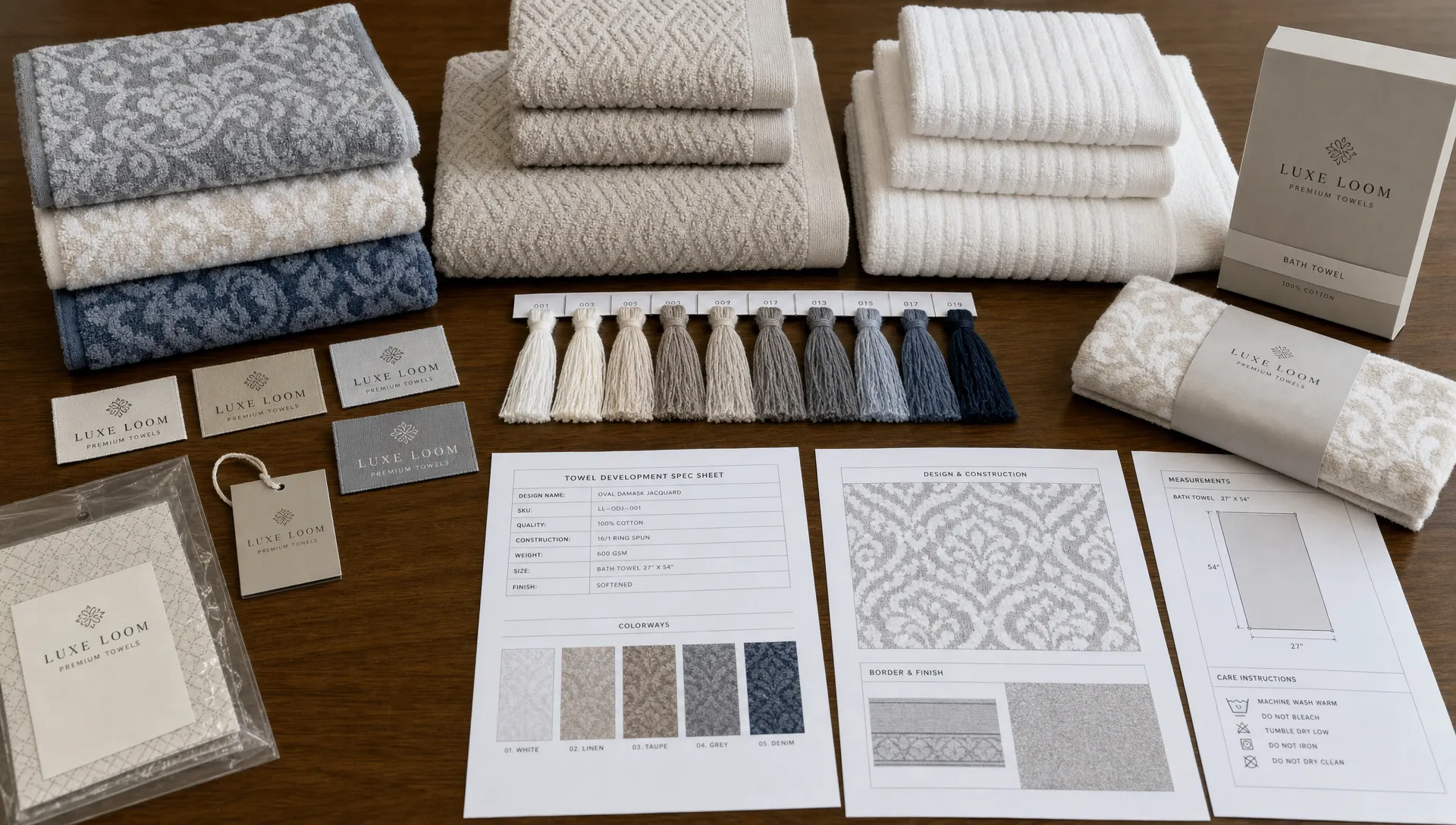
When you receive a jacquard towel sample, inspect more than the front design. Check the reverse side, borders, hems, label placement, edge straightness, lint level, feel after washing and whether the towel returns close to its intended shape after laundering. If the product will be sold in retail stores, test how it looks folded with packaging applied. A towel can be technically acceptable but commercially weak if the logo, color or label placement disappears on shelf.
Keep an approved master sample. For bulk production, this becomes the reference for color, feel, size, design clarity and finishing. Without a master sample, disagreements become subjective.
Look for a Practical Quality Control System
Quality control should not begin when the cartons are ready. For jacquard towels, inspection should cover raw material, weaving, dyeing or yarn color, finishing, stitching, labeling, packing and final carton checks. The goal is to catch problems early enough to correct them without delaying the shipment or compromising the order.
A private-label buyer should ask what the manufacturer checks during production. Useful inspection points include towel size, GSM, color consistency, absorbency, loose threads, holes, weaving defects, border alignment, label accuracy, carton markings and packaging presentation.
International buyers may also ask whether the supplier works with recognized quality and product safety frameworks. For example, ISO 9001 relates to quality management systems, while OEKO-TEX Standard 100 is widely used in textiles for testing against harmful substances. Not every order requires every certification, but a manufacturer should be transparent about what it has, what it can support and what applies to your destination market.
For buyers visiting or auditing a Pakistani supplier, this guide on what to check at a towel factory in Pakistan gives a useful factory-level checklist that goes beyond jacquard towels alone.
Compare MOQ, Capacity and Lead Time Realistically
Minimum order quantity is not just a commercial preference. In jacquard towel production, MOQ can be affected by yarn dyeing, loom setup, design complexity, color count, size range, packaging and whether the order is part of a larger production schedule.
A very low MOQ can be attractive for a new private label, but it may come with higher unit cost, limited customization or less efficient production. A very high MOQ may reduce the unit price but increase inventory risk. The right supplier should help you understand the balance rather than pressure you into a quantity that does not fit your launch plan.
Lead time should also be discussed in stages. Ask separately about sample development, sample revision, bulk production, inspection, packing and export handling. This is especially important for seasonal retail launches, hotel openings, promotional campaigns and distributor commitments.
Reliable manufacturers give realistic timelines and update you if something changes. Be cautious when a supplier promises unusually fast custom jacquard production without reviewing artwork, yarn availability or packaging requirements.
Check Private-Label Support Beyond the Towel
For private labels, the towel is only part of the product. Presentation, compliance and supply consistency shape the final customer experience. A manufacturer that can weave a good towel but cannot manage labels, cartons or export documentation may create extra work for your team.
Private-label support can include woven labels, care labels, hangtags, barcode stickers, carton marks, assortment packing, custom packaging and documentation for export. The exact needs depend on your sales channel. A hotel distributor may need bulk carton packing and clear item codes. A retail brand may need shelf-ready packaging, barcode placement and consistent folding.
If you sell across multiple countries, labeling deserves extra attention. Fiber composition, care instructions, country of origin and language requirements can vary by market. The supplier does not replace your legal compliance review, but it should be able to follow approved label artwork and keep placement consistent.
Compare Pricing by Landed Value, Not Unit Price Alone
A low ex-factory price can become expensive if the towel fails inspection, shrinks outside tolerance, loses softness after washing or arrives in packaging that needs to be reworked. Compare manufacturers by landed value, which includes the product, customization, packing, quality reliability, communication and export performance.
When reviewing quotations, make sure each supplier is pricing the same specification. Confirm size, GSM, yarn or material, design type, number of colors, label details, packing method, carton quantity, shipping terms and sample charges. Small differences in any of these can change the price significantly.
A practical quote comparison table can prevent hidden mismatches:
| Quote item | Supplier A | Supplier B | Supplier C |
|---|---|---|---|
| Size and GSM match brief | Yes or no | Yes or no | Yes or no |
| Jacquard design included | Yes or no | Yes or no | Yes or no |
| Labeling included | Yes or no | Yes or no | Yes or no |
| Custom packaging included | Yes or no | Yes or no | Yes or no |
| Sample process explained | Yes or no | Yes or no | Yes or no |
| Inspection process shared | Yes or no | Yes or no | Yes or no |
| Export documents supported | Yes or no | Yes or no | Yes or no |
This type of comparison makes price discussions more objective. It also shows which suppliers are quoting a complete private-label program and which are quoting only a towel.
Use a Scoring Matrix to Shortlist Manufacturers
Once you have samples, quotes and supplier responses, score each manufacturer against the areas that matter most to your business. A structured scorecard helps reduce bias toward the cheapest quote or the best-looking initial sample.
| Evaluation area | What strong performance looks like |
|---|---|
| Technical capability | Clear understanding of jacquard weaving, artwork conversion and towel construction |
| Sample quality | Good design clarity, softness, finishing, washing behavior and label execution |
| Communication | Fast, specific and organized replies with practical recommendations |
| Private-label readiness | Supports labels, packaging, carton marking and repeatable specifications |
| Quality control | Shares inspection steps and accepts approved sample standards |
| Commercial fit | MOQ, pricing and lead time fit your launch or reorder plan |
| Export experience | Understands documents, packing requirements and destination-market expectations |
Give extra weight to the criteria that affect your risk. A premium retail brand may weight sample quality and packaging higher. A hotel supplier may prioritize durability, absorbency and bulk consistency. A distributor may focus on reorder reliability, carton accuracy and clear communication.
Red Flags When Comparing Jacquard Towel Manufacturers
Some warning signs appear early in the sourcing process. One red flag is a supplier that cannot explain whether it manufactures in-house or outsources key production steps. Outsourcing is not automatically bad, but lack of transparency makes quality control harder.
Another concern is inconsistent information. If the quotation says one GSM, the sample feels different and the packing list uses another description, the supplier may not have a strong specification control system. Private-label programs depend on documentation, especially when multiple sizes, colors and SKUs are involved.
Be cautious with suppliers that avoid sampling, reject reasonable inspection requests or refuse to provide basic production details. Also watch for overpromising. Custom jacquard work has real setup requirements. A manufacturer that promises every design, every color, any quantity and instant delivery may be prioritizing the sale over production reality.
Why Pakistan Is Often Considered for Jacquard Towel Manufacturing
Pakistan has a long-established towel and terry textile manufacturing base, which makes it a common sourcing destination for hotels, wholesalers, distributors and private-label brands. Buyers often look to Pakistan for cotton terry towels, bath linens, hospitality towels and OEM programs because the supply chain includes spinning, weaving, dyeing, finishing, stitching and export services.
That said, country alone does not guarantee quality. The specific manufacturer matters. You still need to compare machinery, materials, sampling discipline, communication, private-label support, inspection systems and export handling. A strong Pakistan-based jacquard towel manufacturer should be able to support custom development while keeping bulk production aligned with approved specifications.
Extreme Towel manufactures terry towels, hotel linens, bamboo bedding and bathrobes in Pakistan for wholesale, hospitality, distributor and private-label customers. If your sourcing plan also includes stock or bulk towel programs beyond jacquard designs, the company’s overview as a wholesale towels supplier for retailers may help you compare broader towel supply options.
Frequently Asked Questions
What should I ask a jacquard towel manufacturer before ordering samples? Ask whether jacquard weaving is handled in-house, what artwork files are needed, which sizes and GSM ranges are available, how colors are matched, what MOQ applies by design or color and whether labels and packaging can be customized.
Is jacquard better than embroidery for private-label towels? Jacquard is often better for larger logos, borders and all-over patterns because the design is woven into the towel. Embroidery works well for smaller logos or monograms, especially in hospitality, but it may not suit large repeated designs.
How do I compare jacquard towel samples from different suppliers? Wash each sample, measure size change, compare softness, check lint, inspect design clarity, review label placement and evaluate folding or packaging presentation. Use the same test method for every supplier so the comparison is fair.
What affects the MOQ for custom jacquard towels? MOQ can depend on design complexity, color count, yarn availability, loom setup, size range, packaging and whether the manufacturer can combine production efficiently. Always confirm MOQ by SKU, not only by total order quantity.
Should I choose the lowest-priced jacquard towel manufacturer? Not automatically. A lower unit price may exclude custom labeling, packaging, inspection requirements or the exact GSM you requested. Compare landed value and production reliability, not only the initial quote.
Build a Stronger Private-Label Towel Program
The right jacquard towel manufacturer should help you protect your brand, not only fill a purchase order. Compare suppliers on technical capability, material quality, sampling discipline, private-label support, quality control and export reliability before you commit to bulk production.
If you are developing custom jacquard towels, hotel towels or retail towel collections, Extreme Towel can support OEM manufacturing, bulk production, private-label customization, quality inspections, custom packaging and global export service from Pakistan. Share your product brief, artwork and target market requirements to start a more accurate supplier comparison.