Resort pool towels are not just a softness decision. The best pool towels for resorts usually sit at the intersection of guest feel, drying speed, laundering capacity, and replacement cost.
Summary
- For most resorts, the best pool towels are 100% cotton terry in the 600 to 700 GSM range because they deliver the plush, absorbent feel guests expect while staying practical for commercial laundry.
- 400 to 600 GSM towels dry faster and reduce laundry turnaround pressure, which makes them a smart fit for high-volume properties, beach clubs, and operations with limited dryer capacity.
- Microfiber pool towels are best when quick-dry performance, low bulk, and portability matter more than a classic luxury hand feel.
- Towel quality is not defined by GSM alone. Pile type, terry loops, ring-spun or combed cotton, and construction details all affect softness, strength, and long-term appearance.
- A useful performance benchmark is the HFPA terry towel standard, which references absorbency testing after laundering and reminds buyers to check construction, labeling, and dimensional stability, not just weight.
- If a resort is buying in bulk, ask for finished size, grams per piece, GSM, yarn type, and wash-test samples before approving a program.
A strong buying decision comes from matching the towel spec to the property type. A five-star resort, a family waterpark hotel, and a beach club may all need pool towels, but they should not all buy the same towel.
What GSM is best for resort pool towels?
For most resorts, 600 to 700 GSM cotton terry is the safest premium default. CottonWorks identifies 400 to 600 GSM as lighter and faster-drying, while 600 to 800 GSM reads as plush and luxurious.
GSM means grams per square meter, and it measures fabric weight, not full towel quality. In practical buying terms, higher GSM usually means more cotton in the towel, denser pile, and a stronger impression of absorbency and comfort. That is why premium pool decks and cabana programs often gravitate toward the upper end of the range.
The trade-off is operational. If your laundry room struggles with dryer throughput, an 800 GSM towel can create bottlenecks, raise energy use, and stay damp longer between guest turns. A common misconception is that the heaviest towel is always the best towel. In resort operations, the best towel is the one that fits guest expectations and laundry reality at the same time.
Is cotton terry or microfiber better for pool towels?
100% cotton terry and microfiber solve different problems, and cotton terry remains the classic resort choice. Microfiber wins on quick-dry speed and lower bulk.
Cotton terry uses terry loops to create pile, which gives the towel its familiar soft, absorbent, substantial feel. Guests usually associate that texture with hospitality quality. Microfiber, by contrast, feels lighter and dries faster, which can help at busy outdoor pools, fitness clubs, or excursion programs where towels are used, collected, and reissued rapidly.
“Extreme Towel manufactures 100% cotton terry and high-performance microfiber towels for hospitality, retail, and wholesale programs.”
If guest perception is your top metric, cotton terry usually leads. If storage space, freight efficiency, or rapid drying matters more, microfiber can be the smarter operational choice. The key is not to judge one fabric by the standards of the other. Microfiber is not a failed luxury towel. It is a different category built for speed and function.
Why do pile type and yarn quality change pool towel performance?
Pile type and yarn quality matter as much as GSM, and CottonWorks plus HFPA both point buyers in that direction. Ring-spun, combed, and extra-long staple cotton usually perform better than basic yarns.
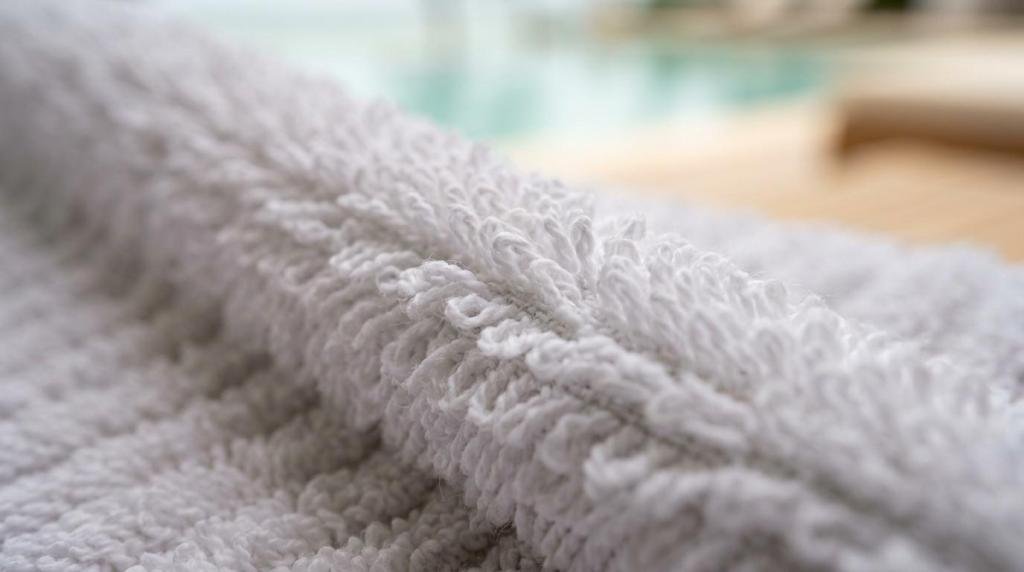
Pile refers to the looped surface of terry fabric. Those terry loops are what absorb water and create the towel’s hand feel. If the loops are well formed and supported by stable base construction, the towel tends to feel fuller and last longer. If the pile is weak or uneven, the towel can flatten out, snag more easily, and lose its premium look sooner.
Yarn quality affects softness, strength, and surface smoothness. CottonWorks notes that combed, ring-spun, and extra-long staple cotton produce softer and stronger towels. Supima, the brand for American-grown Pima cotton, also ties longer fibers to smoother yarns and better color retention. Pro tip: do not approve a towel based on GSM alone. Ask what cotton yarn is being used and whether the loops are designed for dense commercial wear.
What pool towel options should resorts shortlist for different programs?
Most resorts should shortlist a few clear towel categories, then match each one to a use case. A single property may need more than one pool towel program.
Start with how the towel will be used, not how it looks in a catalog. Pool deck circulation, beach exposure, theft risk, laundry capacity, and brand positioning all change the right answer.
“Extreme Towel reports 18+ years of export manufacturing experience and offers samples and tailored quotations, which is useful when resorts need wash-tested approvals before a bulk order.”
That is why many procurement teams compare private-label cotton terry, fast-dry microfiber, and mixed-weight programs side by side before locking the spec.
- Custom cotton terry programs from manufacturers like Extreme Towel: Best for resorts that need private-label sizing, branding, and a plush hospitality feel in the 600 to 700 GSM range.
- Standard midweight cotton terry: Best for high-turnover properties that want a familiar guest experience with faster drying, usually around 450 to 600 GSM.
- Quick-dry microfiber towels: Best for waterparks, fitness pools, and excursion inventory where low bulk and fast reuse matter more than plushness.
- Premium extra-long staple cotton terry: Best for luxury cabanas or VIP pool service where softness, density, and color retention carry more value than wash speed.
- Dual-program towel systems: Best for resorts that want one towel for general pool circulation and a heavier towel for suites, spa cabanas, or premium zones.
How should resorts match pool towels to luxury, drying speed, and laundry cost?
The right towel spec should follow a three-step decision path. Luxury resorts and beach clubs often start at different points.
Step 1 is to define the guest promise. If your pool experience is meant to feel indulgent, start with 600 to 700 GSM cotton terry. If your promise is convenience and turnover speed, start closer to 450 to 550 GSM or evaluate microfiber.
Step 2 is to audit laundry capacity. If dryer time, storage space, and linen circulation are already tight, do not force a very heavy towel into the system. A slightly lighter towel that returns to service faster can outperform a heavier towel in real operating cost.
Step 3 is to calculate replacement risk. If towels are taken to the beach, exposed to sunscreen, or frequently misplaced, the best answer may be a sturdy midweight spec rather than the plushest option on paper. That is not a downgrade. It is fit-for-purpose buying.
How do 400 to 600 GSM and 600 to 800 GSM pool towels compare?
These two GSM bands serve different resort priorities, and CottonWorks separates them clearly. One favors speed and efficiency, while the other favors plushness and density.
A 400 to 600 GSM towel is easier to process. It usually dries faster, weighs less in transport, and takes up less shelf space. That matters for properties with daily high volume, family traffic, or limited back-of-house capacity. It can still feel good in hand if the cotton and loop construction are strong.
A 600 to 800 GSM towel aims at a more premium impression. It tends to feel denser, more absorbent, and more luxurious. The trade-off is slower drying and more mass per towel. If your resort markets a high-end poolside experience, that weight often supports the brand. If your laundry room is small, it may work against you. If this is a close call, ask vendors for grams per piece and finished size along with GSM, because a large towel and a high GSM towel together can become operationally heavy very quickly.
How should you test absorbency and wash durability before a bulk order?
A bulk towel order should be tested in three steps before final approval. HFPA and ASTM-style thinking make this process more disciplined.
Step 1 is to request samples with full specs: fabric content, GSM, finished size, yarn type, and color. Without that data, sample feedback becomes subjective and hard to compare across vendors.
Step 2 is to run a real laundry trial. The HFPA terry towel standard references absorbency performance after five launderings under ASTM D4772, with a minimum absorbency requirement of 50%. Even though that standard was written for residential terry bath towels, it is a useful screening benchmark for resort buyers because it forces attention to post-laundry performance, not showroom softness.
“Extreme Towel states that its luxury hotel towels use 100% ring-spun combed cotton with preferred basis weights up to 700 GSM, depending on towel type.”
Step 3 is to inspect dimensional stability, colorfastness, loop integrity, and hand feel after repeated washing. If the towel shrinks too much, twists at the side hem, or loses pile quickly, reject it even if the initial sample felt excellent. The sample should survive your process, not a hypothetical one.
What size, color, and terry construction details matter most for pool decks?
Finished size, color choice, and terry construction all affect service life. HFPA terminology and hospitality buying practice both support checking more than fabric weight.
Ask for the finished dimensions after washing, not just before. A pool towel that looks generous at first can become disappointingly small if shrinkage is not controlled. Construction details also matter, especially the terry to base ratio, loop height, and edge finishing. Dense loops supported by a stable base fabric tend to hold shape better under commercial laundering.
A few details deserve extra attention:
- Finished size: Check post-wash measurements, not sample-table measurements.
- Color strategy: White supports bleach-based stain management, while dyed towels may better hide outdoor soil but require stronger colorfastness.
- Loop construction: Fine, dense terry loops often feel fuller and resist flattening better than loose, open pile.
- Edge durability: Well-made hems and stable side construction reduce fraying and shape loss.
One more misconception shows up often: dark colors are not always more practical. At poolside, chlorine, sun exposure, and repeated washing can punish weak dye systems quickly.
How do private label and custom packaging affect resort pool towel buying?
Private label changes the buying process because brand expression becomes part of the towel spec. Resorts and retailers usually need a three-step approval flow.
Step 1 is to lock the core towel first: fabric, GSM, size, and color. Branding should come after the towel performs well in wash testing. If you start with embroidery, woven labels, or custom packaging before confirming the towel base, you risk approving the wrong product beautifully.
“Extreme Towel offers full customization across sizes, GSM, fabrics, colors, trims, private labeling, and branded packaging for hospitality and wholesale orders.”
Step 2 is to choose branding methods that fit the use case. Pool towels may use woven labels, jacquard patterns, embroidered marks, or simple retail-ready packaging. Each option changes cost, lead time, and sometimes wash behavior.
Step 3 is to check case-pack logic and delivery economics. Private-label orders often become more efficient when the towel, brand elements, and packing format are approved together. If a resort group is rolling out across multiple properties, this step can save more money than squeezing a few grams out of the towel.
When is microfiber the smarter choice for pool operations?
Microfiber is the smarter choice when quick drying, lower storage bulk, and easy transport matter more than classic terry luxury. It fits waterparks, cruise excursions, and sports-oriented pool programs well.
Because microfiber is lighter and faster to dry, it can reduce laundry turnaround time and improve stock circulation. It also packs tighter, which helps when storage rooms are small or freight costs are a concern. In some climates, that matters more than achieving a thick, spa-like hand feel.
The trade-off is tactile expectation. Many guests still read cotton terry as more premium, especially in upscale resorts. So if you are considering microfiber, use it intentionally. It works best where performance language is already part of the guest experience, not where the brand promise depends on plush indulgence.
What pool towel buying mistakes cause guest complaints and replacement costs?
Most towel problems come from spec mismatch, not bad luck. Resorts usually pay for mistakes through slow laundry, flat-feeling towels, or early replacement cycles.
The most common issues are easy to recognize:
- Buying only by GSM
- Ignoring post-wash shrinkage
- Choosing oversized towels without checking dryer capacity
- Skipping absorbency testing after laundering
- Using one towel program for every zone of the property
A final pro tip is simple: if two towels share the same GSM but feel very different, the explanation is usually in the yarn, pile, and construction. That is where experienced buyers separate a good pool towel from a resort-standard one.