A towel can still feel soft and absorb water well yet look unsuitable for a guest room because of one long, pulled loop. Preventing that damage in terry linens takes more than choosing a heavier fabric: it requires controlling what touches the pile during collection, laundering, finishing and storage.
For hotels, spas and commercial laundries, the most useful distinction is between an isolated snag and a recurring handling problem. Trimming a single damaged loop may save one towel, but it will not solve a rough trolley edge or exposed hook-and-loop fastener that catches the next load.
The practical approach is to remove catching points, check equipment contact surfaces and inspect towels at defined stages. Purchasing decisions matter too, but even a well-constructed towel can snag when its raised loops meet sharp hardware. Start with the handling process before replacing an entire towel specification.
Why terry linens develop snags
Terry fabric has raised pile loops anchored into a woven base. Those loops create an absorbent surface, but they also give hooks, burrs and sharp edges something to catch. When a loop catches and the towel continues moving, the yarn can be drawn outward into a visible pull.
A snag is different from pilling, which produces small balls of tangled fibers, or linting, which releases loose fibers. Abrasion can contribute to several kinds of damage, but the corrective action is not always the same.
Loop height, yarn characteristics and fabric construction influence snag behavior. However, GSM alone does not establish snag resistance. Two towels with the same weight can have different pile structures and respond differently to the same handling conditions.
The location of damage also matters. Random pulls across the pile suggest a different investigation from repeated damage near a sewn label, hem or embroidered area.
Remove catching points during collection and sorting
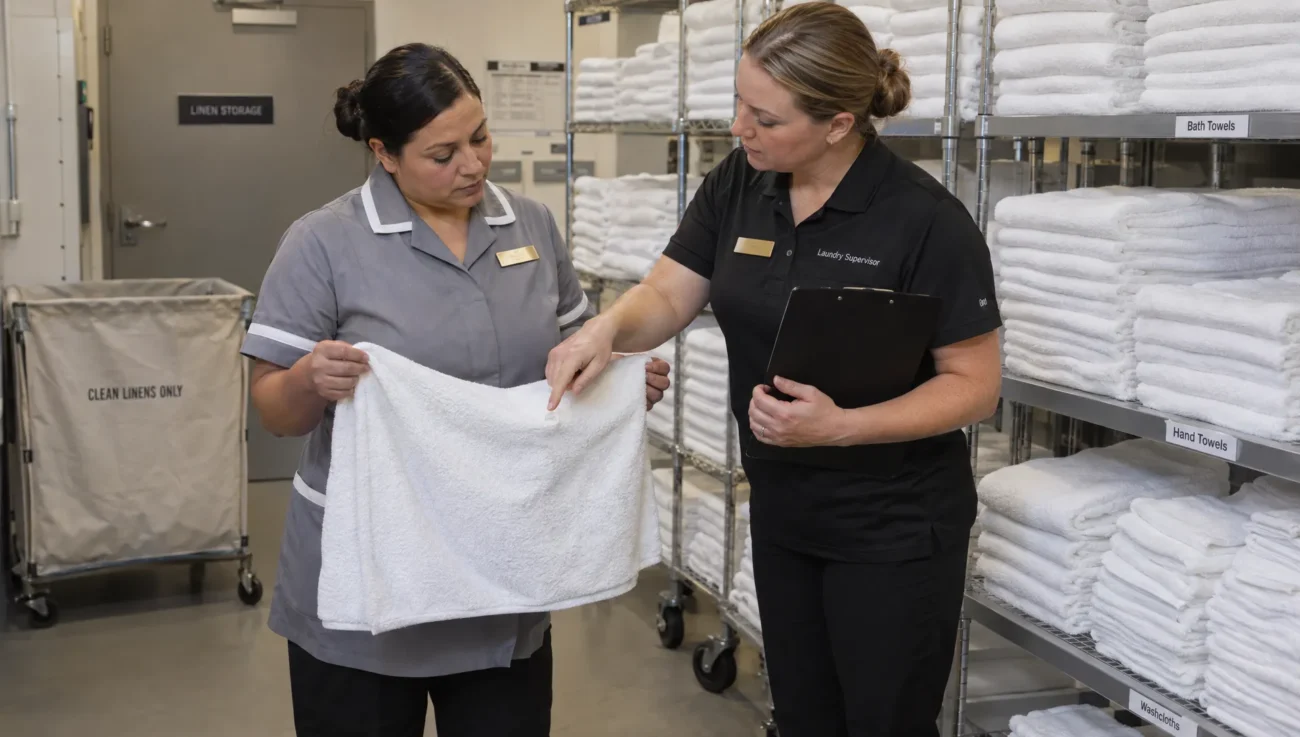
The first opportunity to protect terry linens is before they enter the washer. Collection carts, housekeeping equipment and mixed laundry loads can all introduce snagging hazards.
Keep towels separate from items with exposed zippers, hooks, buckles or hook-and-loop closures. Where workwear or other fastened items must be processed, follow a separate sorting procedure rather than relying on closed fasteners to eliminate every risk.
Check the route from guest bathroom to laundry intake. A cracked plastic bin, projecting screw or damaged cart joint can repeatedly catch fabric. Do not drag towels across floors, door thresholds or equipment edges, and avoid pulling individual pieces forcefully from tightly packed bags.
A short collection-area checklist should cover:
- Rough or broken surfaces on bins, carts and shelving.
- Exposed hardware on collection bags and staff equipment.
- Mixed items containing hooks, zippers or abrasive attachments.
- Overfilled bags that require forceful unloading.
Staff should lift and separate tangled pieces gently rather than pulling against resistance. This is especially relevant when bathrobes with belts or towels with hanging loops become entangled.
If damage is already visible at laundry intake, record it before washing. Otherwise, the laundry process may be blamed for a snag that occurred during guest use or collection.
Control washer loading and equipment condition
Inspect surfaces that contact the fabric
Recurring snags justify an equipment inspection, not just a detergent adjustment. Check accessible drum surfaces, door seals and transfer points according to the equipment manufacturer’s procedures.
Damaged perforations, trapped foreign objects or rough edges may catch loops. Inspections and repairs must be carried out safely, with equipment isolated as required. Do not reach into machinery or search blindly for sharp edges; involve authorized maintenance staff.
If terry linens repeatedly develop pulls after the same machine or transfer stage, separate the affected batch and investigate that route before processing more stock through it. The timing is a useful clue, although it does not prove the machine caused the damage.
Match the load and program to the operation
Overloading can restrict movement and make unloading more difficult. Underloading may also change mechanical action in ways that depend on the machine and program. Use the equipment supplier’s loading guidance for the textile category rather than assuming a tightly packed drum is more economical.
Select chemistry, temperature and mechanical action with the textile supplier and laundry specialist. The care symbols explained by GINETEX provide a starting point, but a commercial laundry also needs written product guidance and a program suited to its hygiene requirements.
Do not lower a validated disinfection temperature simply to reduce fabric damage. Solve the handling or equipment problem while maintaining required hygiene performance.
For operations assessing the wider demands of repeated processing, these considerations for high-volume towel laundering can help frame a supplier discussion.
Reduce damage during drying, unloading and folding
Drying cannot reverse a pulled loop. It can also introduce further catching points if equipment surfaces, lint screens or transfer areas are damaged.
Follow the dryer manufacturer’s loading instructions and the textile supplier’s drying guidance. Avoid unnecessary overdrying, which adds heat exposure and processing time without improving cleanliness. Use the specified cooldown stage before handling the load.
During unloading, support the fabric instead of dragging it over a door edge or pulling it from a compressed pile. If pieces are tangled, separate them without tugging on individual loops, labels or belts.
Protecting terry linens also requires attention after drying. Check folding tables, conveyor joints and storage shelves for rough surfaces. Keep clean stock away from exposed wire ends, damaged baskets and tools used for maintenance or packaging.
Where automated folding equipment is used, note whether pulls appear before or after that stage. Repeated damage in a consistent position deserves a focused inspection of the contact path and settings by trained staff.
Repair an isolated snag without extending the damage
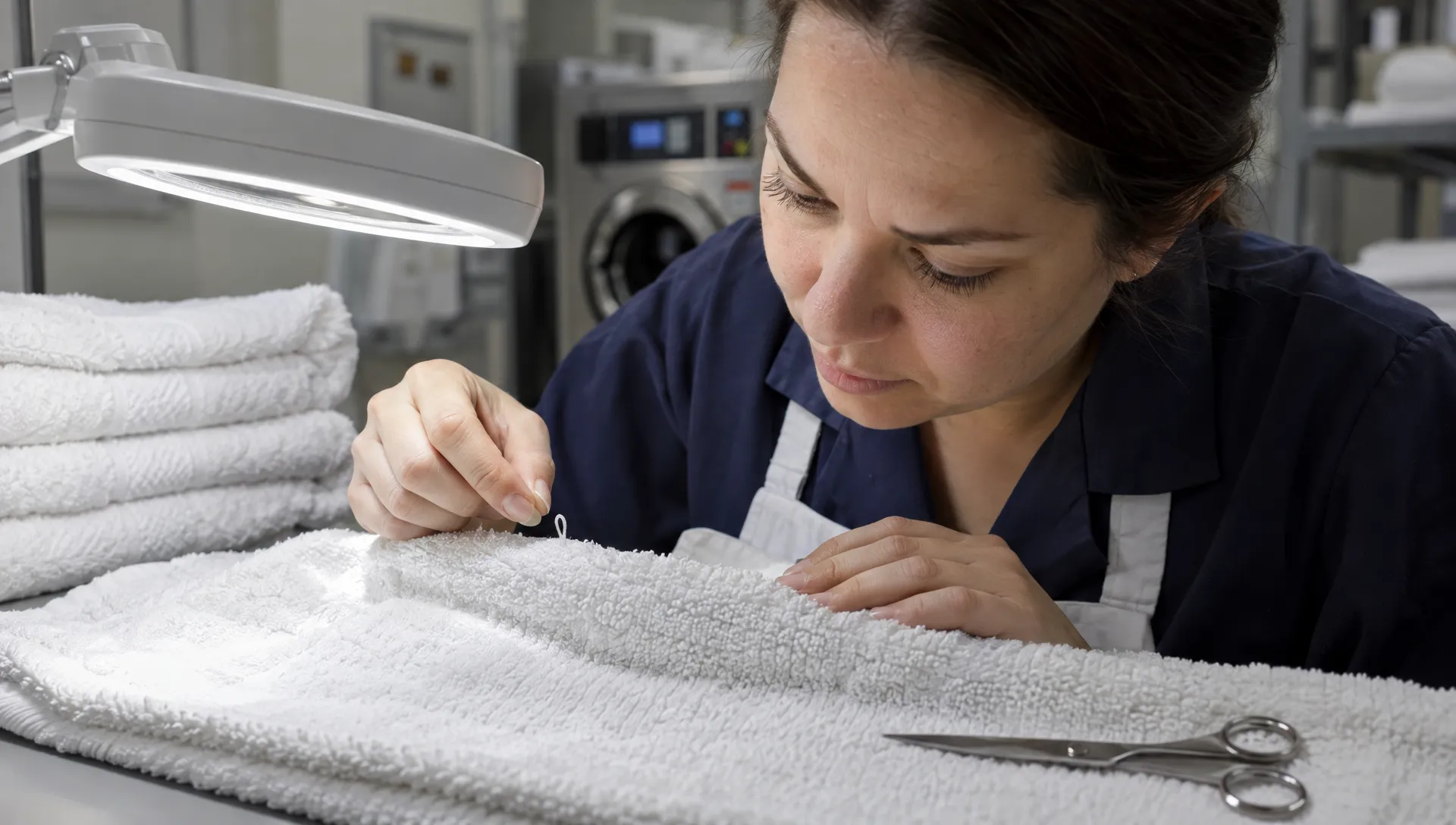
A single extended pile loop does not always mean the towel must be discarded. First, inspect the base fabric under good lighting and gently spread the area without stretching it.
If the woven base is intact and only one pile loop is extended, trained staff can use clean, fine-point scissors to trim the protruding loop level with the surrounding pile. Cut only the raised excess, not into the towel surface.
Never pull the loop to remove it. Pulling can draw out more yarn and turn a small defect into a longer visible line.
For terry linens with several adjacent pulls, a hole or a visibly disturbed base weave, take the item out of guest service for assessment. Do the same when damage affects a hem, seam or structural attachment. Do not treat every loose thread as a pile snag: seam threads and intentionally sewn hanging loops require a different repair decision.
After trimming, check both sides and reassess appearance against the property’s presentation standard. Repairing the visible defect does not identify its cause, so repeated cases still need a process investigation.
Use damage patterns to narrow the investigation
Inspecting only at final folding makes it difficult to locate the source. Instead, compare the condition of representative pieces at receipt, after washing and after drying or finishing.
| Where damage is first observed | Possible area to investigate | Useful next check |
|---|---|---|
| On unused stock | Manufacturing, packing, transport or unpacking | Compare unopened cartons and retain affected samples |
| At soiled-linen intake | Guest use, collection bags or carts | Inspect collection routes and mixed items |
| After washing | Sorting, washer contact surfaces or unloading | Compare machines and review maintenance findings |
| After drying or folding | Dryer surfaces, transfer points or finishing equipment | Inspect the relevant contact path |
These observations are clues, not definitive diagnoses. A small pull can remain unnoticed until a later inspection, so use consistent lighting and the same inspection method at each stage.
Choose construction through practical sample trials
When buying replacement stock, ask suppliers about pile construction and intended laundering conditions rather than selecting on softness and weight alone. Taller, more exposed loops may be easier for projecting objects to catch, but no single construction detail guarantees performance.
For terry linens, the strongest purchasing evidence is a controlled trial using the actual laundry route. Request representative samples and agree on the specification before testing. Document their initial condition, process them under the intended program and inspect them at consistent intervals.
Compare candidates under equivalent conditions. Using one towel in a light domestic wash and another in a heavily loaded commercial machine will not produce a meaningful comparison.
Your trial should consider appearance alongside absorbency, dimensional change, drying performance and seam condition. A fabric that avoids visible pulls but creates other operational problems may not be the right choice.
The specification should also define acceptable workmanship and how visible pulls will be assessed at incoming inspection. These wholesale towel specifications buyers should compare provide a broader framework for documenting the purchase.
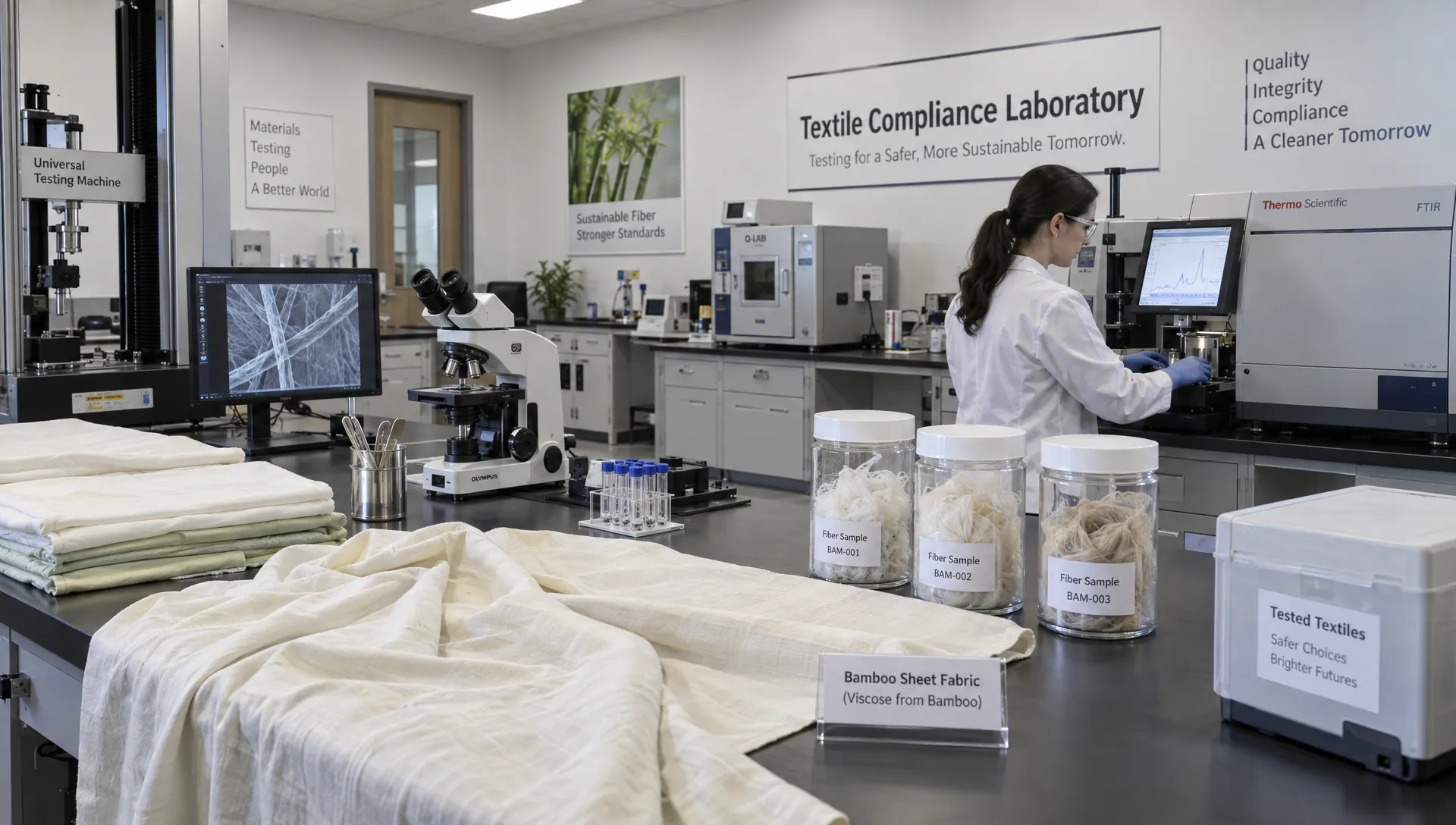
If a laboratory snagging assessment is requested, ask the laboratory to confirm that its proposed method is suitable for the particular terry construction. Do not assume that a test used for another fabric category will answer the same question.
Track newly damaged pieces, not just total rejects
A simple damage log can distinguish an occasional accident from an ongoing process issue. Record the product batch, machine or processing route, inspection stage and type of damage. Photographs help staff distinguish a pulled pile loop from seam failure or abrasion.
For terry linens, a useful internal measure is the number of newly snagged pieces divided by the number inspected, multiplied by 100. Record the actual counts as well as the percentage, because a small sample can produce a misleadingly large change.
Inspect before processing so existing defects are not counted as new damage. Keep sample size, inspection conditions and processing exposure reasonably consistent when comparing batches.
Change one suspected factor at a time where practical. For example, replace a damaged collection cart and then check whether newly observed pulls decline on that route. If sorting, chemistry, machinery and towel specifications all change together, identifying the effective correction becomes much harder.
Frequently asked questions
Should you pull a loose loop back into a towel? Do not tug on it. Pulling can extend the damage or disturb nearby loops. Inspect the base fabric first and have trained staff trim an isolated excess pile loop only when appropriate.
Do heavier towels resist snags better? Not necessarily. GSM measures fabric weight per unit area, not snag resistance. Pile structure, yarn characteristics, construction and handling all affect performance.
Can fabric softener prevent snags in terry linens? Fabric softener does not remove the physical hazards that catch loops. It is not a substitute for sorting, equipment maintenance or sound handling, and product use should follow the textile supplier’s laundry guidance.
When should a snagged towel leave guest service? Remove it when there is a hole, damaged base weave, significant pulled yarn or compromised seam. An isolated trimmed loop may be acceptable if the towel remains sound and meets the property’s appearance standard.
Discuss snag prevention before your next bulk order
Extreme Towel manufactures terry towels and hotel linens in Pakistan, with OEM production, private-label customization and bulk supply. When discussing a project with Extreme Towel, share your laundry conditions, examples of existing damage and presentation requirements. Use those details to agree on a specification and sample-evaluation plan before committing to bulk production.