An AQL inspection checklist for bulk sheets should do more than identify stains or loose threads. It should define the shipment being inspected, establish a defensible sampling plan and separate cosmetic defects from failures in fit, labeling or laundry performance. Without those rules, a supplier and buyer can inspect the same shipment and reach different acceptance decisions.
The essential sequence is: approve the specification, define the lot, select random samples, inspect against agreed criteria and document the release decision. Acceptance Quality Limit (AQL) sampling supports that process, but it does not replace product testing or guarantee that every sheet is defect-free.
For hotels, distributors and private-label bedding brands, the most useful checklist connects each inspection point to a measurable requirement. It also identifies failures that must stop shipment regardless of the visual inspection result. Use the framework below to build those requirements into your purchase order and inspection instructions before production begins.
Plan the AQL inspection for bulk sheets
Define the product specification and inspection lot
Start with an approved specification sheet, not a general description such as “hotel-quality white bedding.” Record the product type, fiber composition, fabric construction, finished dimensions, tolerances, color reference, stitching requirements and packaging configuration.
For fitted sheets, include mattress dimensions, pocket depth and elastic requirements. For sets, identify every component and its quantity. The approved sample should support these written requirements, not replace them.
When buying bulk sheets, define the inspection lot narrowly enough that the samples represent the goods awaiting release. One lot might contain a single SKU made from the same fabric batch under comparable production conditions. Different constructions, finishes or production batches may require separate lots rather than one blended result.
Before inspection, confirm:
- Inspection unit: One individual sheet or one complete set, with a clear rule for component failures.
- Lot quantity: The actual number of units presented for inspection, supported by the packing list.
- Readiness: The required completion and packing status, agreed before the inspector arrives.
- Reference documents: Purchase order, specification revision, approved sample and label artwork.
- Release authority: The person authorized to accept, reject or approve a documented concession.
Select the sampling standard and acceptance rules
Specify the standard and edition, inspection level, normal or tightened status, sampling type and AQL for each defect class. ASQ’s guidance on Z1.4 and Z1.9 distinguishes attribute sampling, which evaluates conforming or nonconforming items, from sampling based on measured variables.
A visual inspection typically uses an attributes plan, such as one selected under ANSI/ASQ Z1.4 or ISO 2859-1. Follow the chosen standard rather than mixing tables or switching rules from different systems.
For bulk sheets, AQL 2.5 for major defects and 4.0 for minor defects can serve as illustrative buyer-selected settings, not universal requirements. The appropriate settings depend on the product, contract and consequences of failure.
AQL is a sampling-plan parameter. It does not mean that an accepted shipment contains no more than the stated percentage of defective units. For continuing supply, define the applicable switching rules. An isolated purchase also needs an appropriate sampling arrangement rather than an assumption that ongoing-lot protections apply.
Worked example: a 2,000-sheet inspection lot
Assume a homogeneous lot of 2,000 individual sheets, normal inspection, General Inspection Level II and a single-sampling plan. Under the commonly used tables in these attributes standards, this produces code letter K and a sample size of 125 units.
The following example uses buyer-selected AQLs of 2.5 for major defects and 4.0 for minor defects:
| Defect class | Example acceptance rule | Decision for the 125-unit sample |
|---|---|---|
| Critical | Contractual acceptance number 0 | Hold or reject upon finding one critical nonconforming unit |
| Major | AQL 2.5, acceptance 7, rejection 8 | Accept this category at 7 or fewer; reject at 8 or more |
| Minor | AQL 4.0, acceptance 10, rejection 11 | Accept this category at 10 or fewer; reject at 11 or more |
Confirm these values against the specified standard and edition before issuing inspection instructions. The critical-defect rule above is contractual, not an “AQL zero” table entry.
For this bulk sheets example, count each sampled sheet once at its highest defect severity, while recording every observed defect. If the contract uses another counting method, document it before inspection.
A result of six major and nine minor nonconforming units passes these two categories. It still cannot authorize release if a critical defect or mandatory performance requirement fails.
Use a product-specific inspection checklist
Randomly select units across the lot rather than taking only accessible sheets from the top of a few cartons. Include different carton positions and production identifiers where available. If different SKUs require separate decisions, give each its own sampling plan.
The checklist should distinguish checks on individual sheets from carton checks and separate laboratory tests.
| Inspection point | What to examine | Acceptance reference |
|---|---|---|
| Product identity | SKU, flat or fitted construction, size and set components | Purchase order and packing list |
| Fabric appearance | Holes, tears, weaving faults, stains and foreign material | Defect catalogue and approved sample |
| Shade consistency | Variation within a sheet, between panels or across sampled units | Approved color reference and viewing conditions |
| Sewing | Open seams, skipped stitches, unsecured ends, hems and seam alignment | Construction specification |
| Finished dimensions | Width, length, pocket depth and measurement points | Size specification and tolerances |
| Elastic and fit | Placement, attachment, recovery and retention on the intended mattress | Approved construction and fit protocol |
| Labels | Fiber wording, origin, care information, identity and placement | Approved artwork and destination requirements |
| Packaging | Correct quantities, assortment, identification, protection and carton condition | Packing specification |
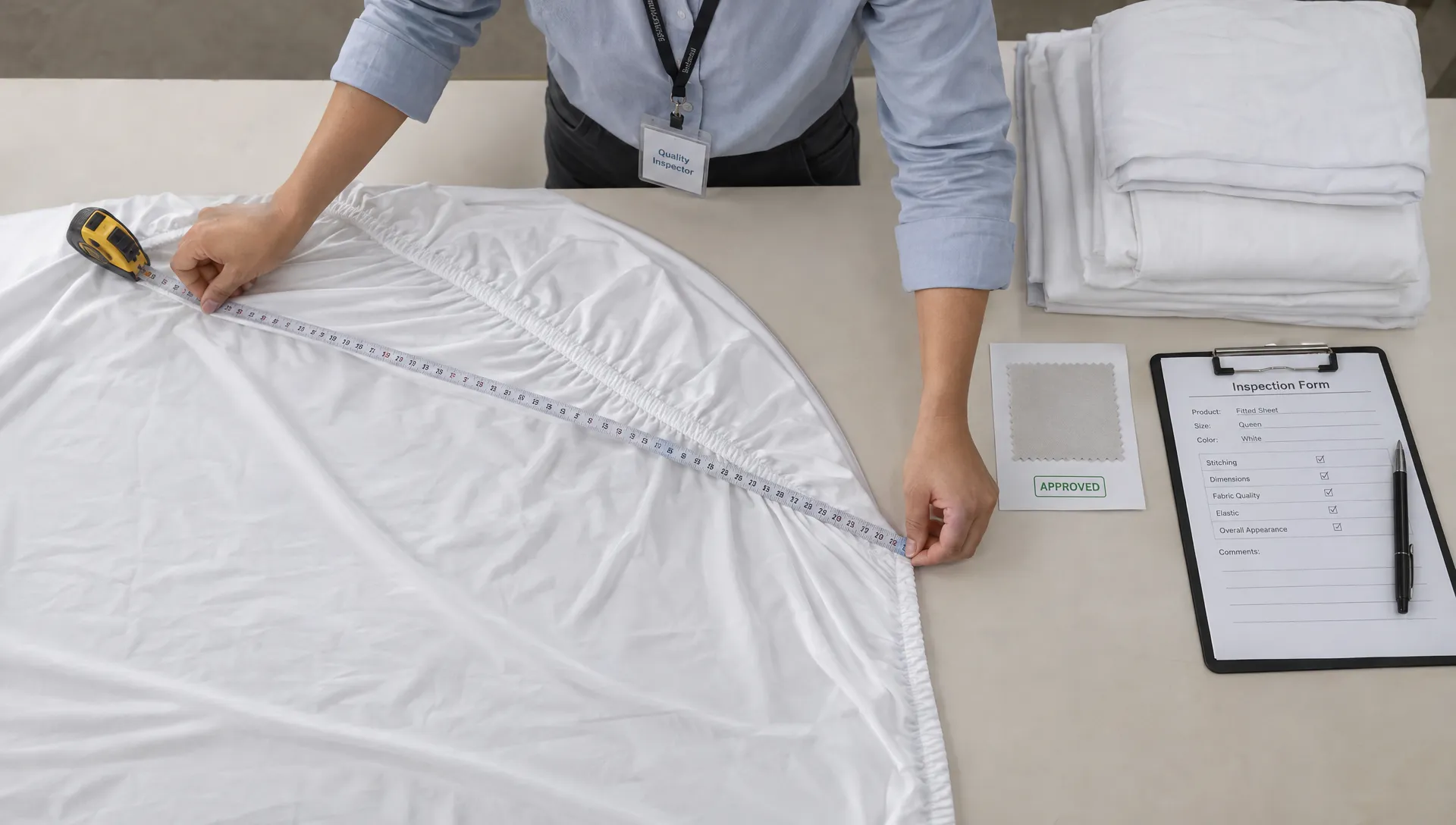
For bulk sheets, record actual observations and measurements rather than marking every row “OK.” A measured width, photographed seam opening or identifiable label discrepancy makes the result easier to verify and resolve.
Measure dimensions and test fit consistently
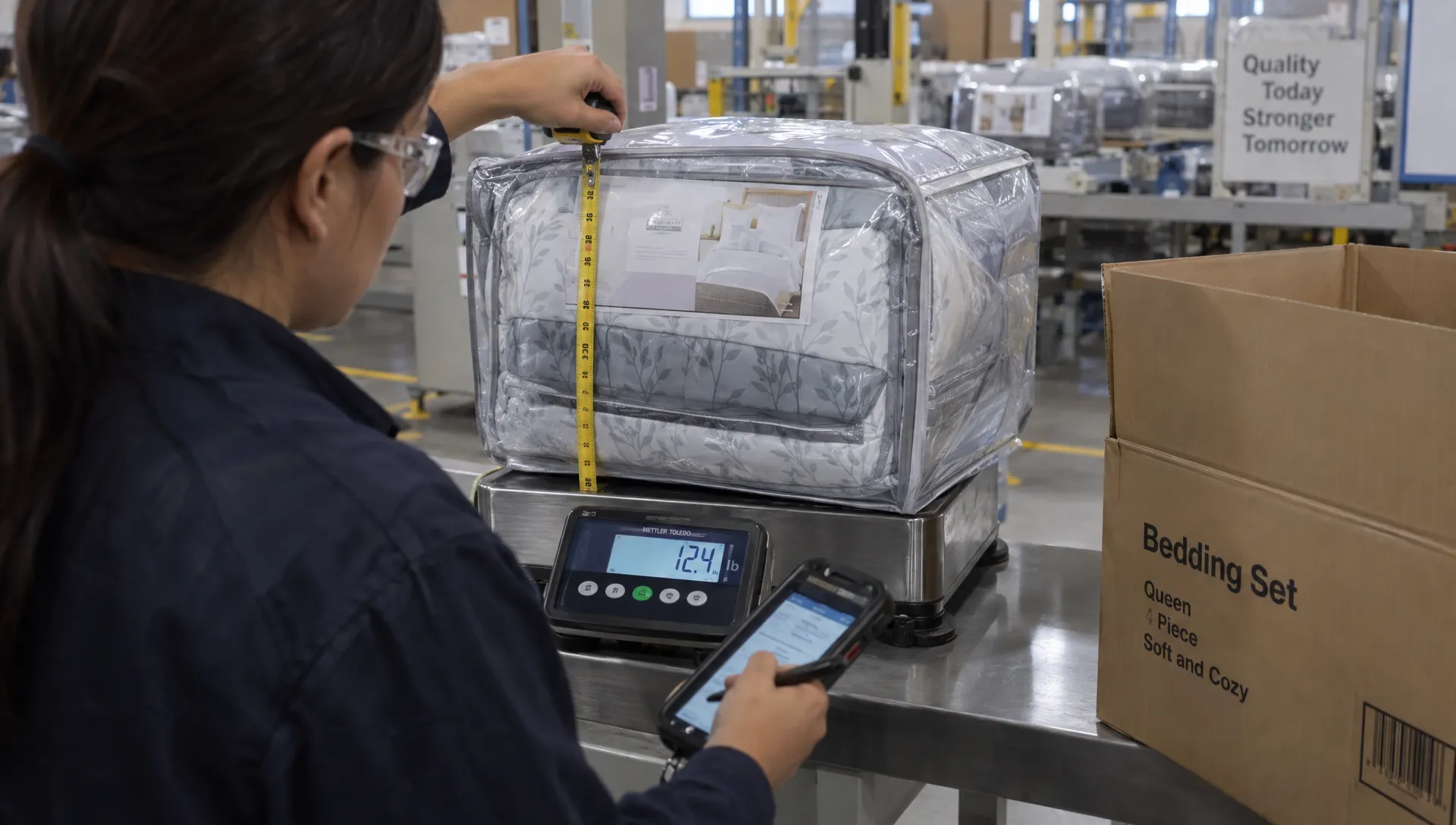
Lay each selected sheet flat without stretching it. Use the specified measurement points and record the result beside the permitted range. If conditioning is required by the test method or contract, follow it before measurement.
Keep finished dimensions separate from post-laundering dimensions. A sheet may meet its delivery specification yet become unsuitable after washing. Do not apply a generic tolerance simply because the purchase order omitted one; resolve the missing requirement with the buyer.
For fitted products, measure more than the nominal mattress size. Check pocket construction, corner seams and elastic attachment, then assess fit on a mattress or fixture representing the intended dimensions and depth. Extreme Towel’s guide to specifying custom-size bed sheets provides useful context for defining that fit before production.
A dimensional checklist for bulk sheets should state whether measurements apply before washing, after washing or at both stages. This prevents an inspector from approving initial dimensions against a requirement intended for laundered goods.
Keep laundry and laboratory tests separate
Do not treat a passed visual sample as evidence of wash durability, fiber composition or fabric strength. These require separate methods, specimens and acceptance criteria.
Depending on the product specification, testing may cover dimensional change, appearance after laundering, colorfastness, pilling, tensile or tear strength and elastic performance. Verify fiber composition or thread count through suitable testing when those claims form part of the purchase requirements.
For dimensional change, a method such as ISO 5077 must be paired with an agreed washing and drying procedure. State the number of cycles, loading conditions, temperatures and finishing steps. A domestic wash procedure should not automatically stand in for the hotel’s commercial laundry process.
Select test specimens according to the applicable method and ensure they represent relevant fabrics, finishes and colors. Do not assume that the visual-inspection sample size also determines the laboratory sample size.
The release plan for bulk sheets should therefore have separate gates: an acceptable shipment inspection, satisfactory required test results and compliant documentation. Pending or failed test results cannot be converted into a pass by a favorable cosmetic inspection.
Agree on defect severity before inspection
A defect catalogue should describe the fault, its severity and any size or location threshold. Include photographs where practical. Classification should reflect safety, usability, durability and the agreed appearance standard, not the inspector’s preference.
The examples below are starting points for buyer-supplier agreement:
| Classification | Working definition | Possible examples |
|---|---|---|
| Critical | A condition creating an unacceptable safety risk or another contractually defined shipment stop | A sharp metal fragment embedded in a sheet |
| Major | A fault likely to impair use, fit, durability or saleability | A hole, open structural seam, wrong size or missing fitted-sheet elastic |
| Minor | A workmanship or appearance issue that does not materially impair intended use | A small untrimmed thread or slight hem irregularity within agreed limits |
For bulk sheets, stain severity may depend on visibility, extent and the product’s intended use. Define those boundaries rather than assuming every stain belongs in the same category.
Incorrect fiber or origin labeling may require a separate compliance hold. Do not assume that mandatory labeling failures can be accepted simply because the visual defect count remains below an AQL threshold.
Check packing without losing unit traceability
Product quality and packing accuracy are related but different checks. A shipment can contain acceptable sheets in incorrectly identified cartons, creating receiving errors and costly sorting work.
Compare carton markings with the packing list, then verify selected carton contents against the stated SKU, size, color and quantity. For sheet sets, confirm that each required component is present. Check the condition of inner packaging and cartons, including visible wetting, contamination or damage.
Keep carton-level findings separate from the sheet-level defect count unless the agreed plan explicitly combines them. If carton quantities or assortments need a statistical acceptance decision, define that inspection unit and sampling plan separately.
Traceability matters when inspecting bulk sheets because a photograph without a carton or sample identifier may not help the factory locate the affected goods. Record which carton supplied each sampled unit and retain relevant batch identifiers.
Packing requirements should be settled before shipment inspection. The guidance on packaging mistakes bedding brands should avoid helps connect product protection, labeling and warehouse handling to the packing specification.
Document the decision and control rejected lots
An inspection report should allow someone who was not present to understand what was checked and why the shipment passed, failed or remains on hold.
Record the supplier and production location, purchase order, SKU, lot size, quantities presented, inspection date and reference documents. Include the sampling standard, inspection level, code letter, sample size, AQL settings and acceptance/rejection numbers.
Attach dimensional results, defect counts by severity, labeled photographs, packing findings and required test reports. Identify uncompleted checks rather than leaving blank fields that could be mistaken for a pass.
If bulk sheets fail inspection, hold shipment pending an authorized disposition. The supplier’s corrective action should address the affected scope, such as documented sorting, repair or replacement, followed by verification under the agreed reinspection procedure.
Do not repeatedly draw fresh samples until one passes. That changes the decision process and weakens the protection of the original plan. Preserve the initial findings, identify the corrected goods and document the new inspection result.
Any concession should name the deviation, affected quantity and approving authority. A commercial concession does not remove an applicable legal requirement or make an unresolved safety issue acceptable.
Frequently asked questions
Does AQL 2.5 mean that 2.5% of the shipment may be defective? No. It is a parameter used to select a sampling plan. Acceptance depends on the sample size and acceptance number, and it does not establish the shipment’s exact defective percentage.
How many sheets should an inspector check? The number depends on the lot size, inspection level and selected plan. In the worked example, 2,000 individual sheets under normal, General Level II single sampling produce a 125-unit sample. Other settings can produce different requirements.
Should every size and color be included? The plan for bulk sheets should define which products form each lot and which need separate decisions. A combined sample can conceal a problem affecting a smaller SKU, color or fabric batch.
Does zero acceptance for critical defects guarantee a safe shipment? No. Finding none in a sample does not prove none exist elsewhere. Safety risks may require validated process controls, appropriate screening and other preventive measures beyond acceptance sampling.
Can the supplier inspect its own shipment? Supplier inspection can support quality control. The buyer should still define the evidence required for release and whether independent inspection or verification is necessary.
Build inspection requirements into your order
Extreme Towel manufactures hotel linens and offers OEM production, private-label customization, quality control inspections and export support. When discussing your next order with Extreme Towel, share the product specification, defect catalogue, sampling requirements and required test methods. Agreeing on these documents before production gives both parties a clear basis for inspection and shipment acceptance.